Upgrading Your Benefits Broker Without Touching Your HRIS Stack
Standalone brokers can layer atop your HRIS without forcing an expensive system overhaul.
A company can upgrade its benefits broker without replacing its HRIS. Modern benefits brokerage sits on top of existing HR infrastructure, handling carrier access, plan design, compliance support, and employee service while the employer keeps its HR software. The employer must assign those responsibilities and move coverage without gaps.
Why benefits and HRIS are separate problems that companies keep treating as one
Renewal arrives, service feels generic, and someone asks what it would cost to change brokers. No one knows where the broker ends and the HRIS begins, so a service improvement starts to look like a systems project. Under a PEO, that confusion follows from the arrangement itself, because co-employment bundles payroll, HR technology, and benefits access.
A standalone or AI-native broker serves a different role. The employer remains the sole employer of record, retains its HRIS, and engages the broker for benefits work. Carrier relationships and plan advice belong to that relationship, while employee records and payroll workflows belong to the HR infrastructure. A broker switch is therefore a vendor relationship change, although leaving a PEO also requires a deliberate handoff of responsibilities previously bundled together.
The stage at which PEO bundling stops serving a tech company and starts constraining it
PEOMetrics' startup guide describes the early value of a PEO for founders without a dedicated HR hire. The arrangement provides access to large-group benefits pricing and compliance coverage that a small team cannot readily replicate independently. That is a genuine operating advantage. A company can obtain benefits and administrative support before it has the internal capacity to manage them separately.
As the company grows, however, the same arrangement can become restrictive. Plan design stays within the PEO's menu, and workflows must conform to the provider's system. Fees scale linearly with headcount even though HR complexity does not. The original fit can weaken without the provider failing.
PEOMetrics' exit playbook frames PEO exit as a mainstream planning issue for growing employers. The playbook identifies signals including defensive renewals, multi-state complexity that outpaces standardized service, and internal processes built around provider constraints. Finance may also find it hard to compare the bundled charges with what other options cost. These structural signals explain why a company can value what the PEO provided and still need a different arrangement.
What an operator actually gives up — and keeps — when separating the benefits layer from the HRIS
The clean operational boundary places payroll workflows, employee data, onboarding connectors, and existing system integrations on the retained side. The employer replaces the arrangements for carrier relationships, control over plan design, and benefits compliance support. Employees can continue using the HRIS for time off, payroll visibility, and onboarding documents. Those functions were never the broker's domain. Enrollment data and carrier feeds still require transition work, but that work is distinct from replacing the employee record system.
What the employer gives up is the PEO's bundled benefits arrangement and its contracted plan menu. In return, the employer gains control over plan design and access to the full carrier market. That opens options including level-funded plans, HDHPs with HSA structures, and alternative funding arrangements that PEOs rarely accommodate. With more choice, the employer still needs someone to handle administration. It changes who makes the decisions and who supports their execution.
The handoff therefore needs attention in three specific areas, namely coverage continuity, employee communication, and compliance ownership. Employees must not lose coverage between arrangements, and they need to understand which parts of their benefits experience are changing. The exit playbook treats communication as an operating control. The employer now takes on ACA reporting, COBRA administration, and Form 5500 work that the PEO used to handle. Retaining the HRIS does not retain the PEO's services.
The compliance obligations that transfer to the employer when the PEO exits — and why they arrive by headcount, not by decision
Benefits compliance obligations arise through workforce and plan growth. Hiring can trigger a requirement before anyone has explicitly considered it. The transition exposes who must monitor those thresholds and perform the work. It does not create a fresh choice about whether to comply. An employer that has relied on the PEO must distinguish between keeping a system and keeping someone accountable for compliance.
Each headcount threshold counts employees in a different way, so the same total will not work for every requirement. When the count crosses 20 employees, federal COBRA continuation coverage rules apply, with full-time and part-time employees included and part-timers counted as fractions. When the count crosses 50 full-time equivalents, the ACA employer mandate and its 1094-C/1095-C IRS reporting rules apply. The mandate requires offering minimum-value, affordable coverage to full-time employees. These measures need an owner who tracks their application.
Form 5500 introduces a separate plan-participant threshold. Having 100 or more plan participants at the beginning of the plan year triggers annual reporting for fully insured or unfunded plans. Self-funded plans held in trust must file no matter how many participants they have. Federal requirements are also only part of the picture. California and New York add continuation coverage rules, while state-specific training mandates and workers' compensation requirements apply from the first hire in each state.
Compliance monitoring also informs plan design. The ACA affordability percentage for plan years beginning in 2026 provides more room to adjust employee premium contributions than the prior year's threshold did. That is a renewal lever as well as a compliance parameter. A broker that actively benchmarks plans should flag it. The employer needs ongoing attention to these changes after PEO exit.
Can a benefits broker work on top of the existing HRIS without replacing it?
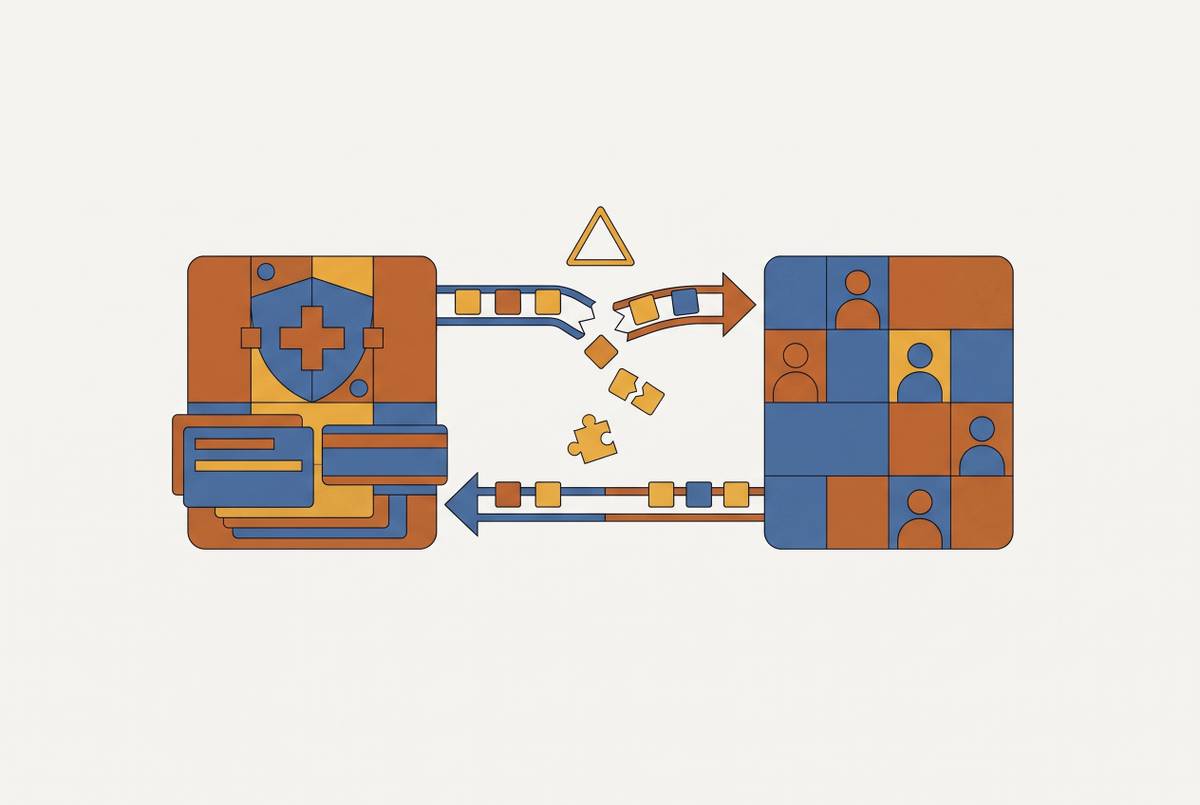
A standalone or AI-native broker operates at the carrier and plan level, while standard connectors and exports move data between its tools and the employer's HRIS. The integration does not require a replacement HR system. In a concrete enrollment flow, enrollment data goes to the carrier, the carrier confirms coverage, and the HRIS records enrollment status. The broker relationship changes around that flow. The employer's existing benefits administration tool remains the place through which enrollment can be facilitated.
This separates technical compatibility from the breadth of service. A well-structured engagement includes carrier negotiation and plan design across the full available market. It also includes ongoing monitoring across ACA, COBRA, ERISA, Form 5500, and relevant state requirements. Open enrollment support covers employee communication and enrollment facilitation.
Employee support is another part of that layer. An around-the-clock concierge model gives employees a route for benefits questions beyond a PDF and an 800 number. That service can change without changing where employees access payroll information or onboarding documents. The operator still needs evidence that the broker can deliver the compliance and support scope previously obtained through the PEO.
What to evaluate when selecting a broker that can actually replace what the PEO was providing
Before signing, an operator should check six things the broker can do, beyond its broad promise to provide a full service. The first is plan design breadth. The operator should check whether the broker has access to the full carrier market, including level-funded and alternative funding options, or mainly offers fully insured small-group plans. The ability to model alternative funding arrangements is a meaningful distinction at the stage where PEO exit becomes relevant. Access alone is not the same as useful plan analysis.
The second criterion is explicit compliance coverage. The operator should ask whether the engagement includes ongoing ACA reporting support for 1094-C/1095-C, COBRA administration or coordination, Form 5500 preparation, and multi-state monitoring. The distinction is between work the broker performs or coordinates and work returned to the employer after setup. General assurances leave that boundary unresolved. The scope needs to show how the former PEO responsibilities will be supported.
The third criterion is documented renewal discipline. The operator should ask for proof of market benchmarking at every renewal instead of taking it on trust that the broker will push the current carrier to compete. A traditional broker's commission structure can create an incentive toward inertia. Documented renewal analysis tests the practice. It also makes clear whether broader carrier access will actually be used.
The fourth criterion is the employee support model. The operator should establish what happens when an employee has a claims question or a mid-year life event, including whether support comes from a dedicated concierge or a call center. The fifth criterion is HRIS integration experience.
The sixth criterion is compensation transparency. Brokers are paid by carriers, and the operator should request full disclosure of commission arrangements. That structure is legitimate and keeps the service free to the employer, but opacity makes incentives harder to assess. The operator should review how the broker is paid alongside the renewal evidence. Together, they help the operator judge whether the broker's commercial arrangement supports the promised breadth of advice.
How to sequence the actual transition so benefits never lapse and the HRIS never notices
The exit playbook lays out a sequence that begins with ownership. During months one and two, the employer audits the census, plan details, carrier contracts, and enrollment files. It also identifies every compliance obligation the PEO was handling and maps each one to a new owner. This work comes before issuing any notice. The purpose is to establish what must be replaced while the current arrangement is still in place.
During months three and four, the employer secures the new broker and carrier relationships. Effective dates must align with the PEO contract termination and the new plan year. Formal notice follows only after replacement coverage is confirmed. Coverage comes before contract exit in this sequence.
During months five and six, enrollment data moves to the new carrier feeds, and the employer checks that HRIS connectors send it to the right place. Employee communication runs as an operating control throughout this stage. Employees need to know what changes, what stays the same, and where questions should go.
Moving on January 1 avoids the mid-year employment tax complications that come with leaving a standard, non-CPEO PEO. Leaving an IRS-Certified PEO at other points in the year has fewer ramifications. The distinction belongs in transition planning before notice. It affects when to move even though it does not change the architectural separation between brokerage and HR software.
The first independent plan year's open enrollment is also the point to apply the updated 2026 ACA affordability threshold, evaluate updated out-of-pocket maximums, and review the FSA contribution limit increase. A benchmarking-focused broker should bring those decisions forward proactively. The systems work remains narrow by comparison. HRIS involvement is limited to enrollment data and carrier feeds. What moves is the benefits relationship and its supporting data.