Benefits Data Sync Errors Between Brokers and HRIS Platforms
Sync errors trace back to source data, mappings, and timing.
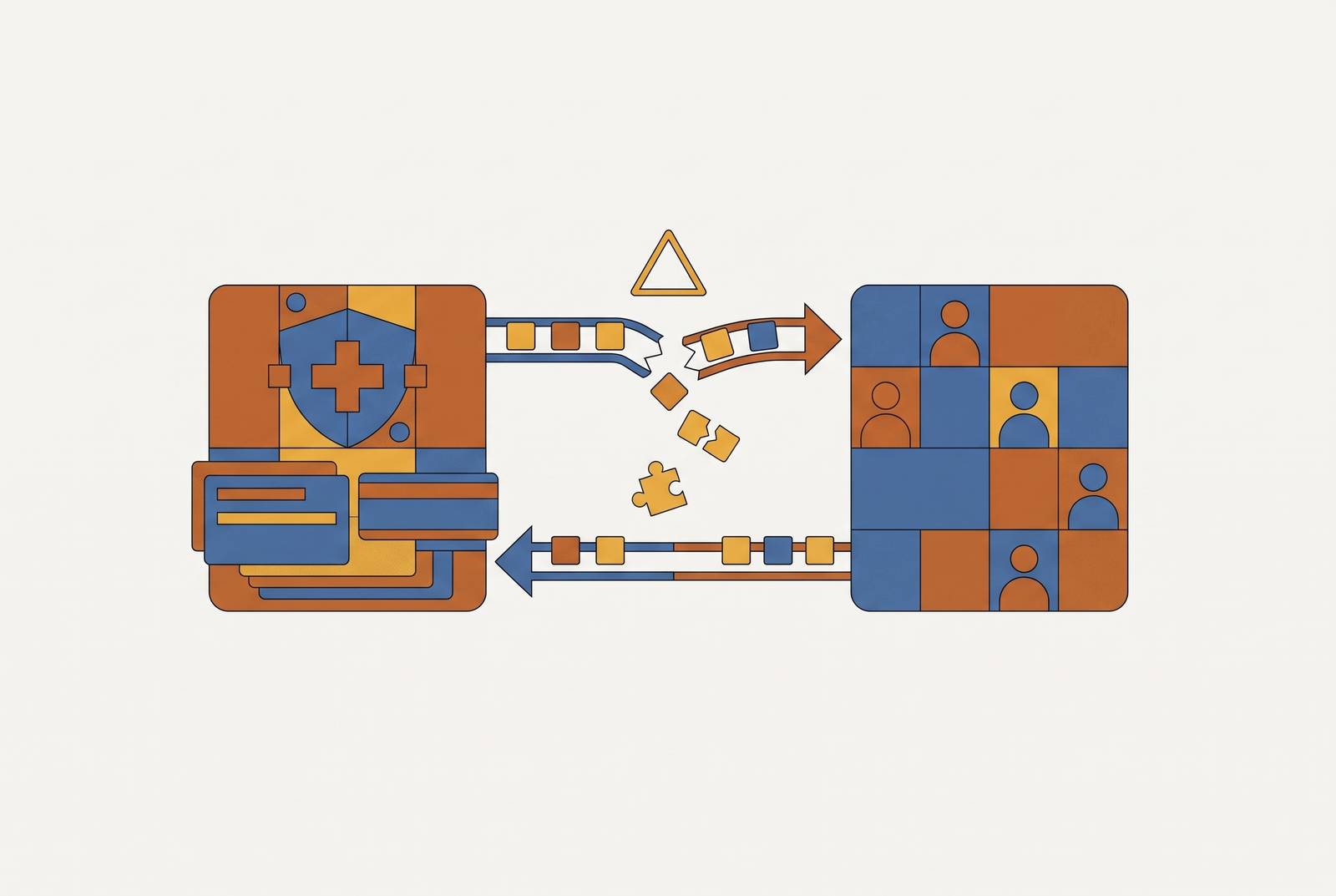
A benefits broker can work on top of an existing HRIS without replacing it, provided its service includes ongoing integration oversight. Benefits data sync errors usually start with problems that can be prevented in source records, field mappings, or transmission schedules. Better brokerage therefore depends on who maintains those connections and resolves discrepancies.
Why benefits data sync errors are a benefits administration problem, not a technology problem
An employee arrives at a doctor’s office and discovers that coverage is inactive. The enrollment selection may look right in the benefits platform, but the carrier’s record may show something else. That is often where discovery begins. Alternatively, a carrier audit exposes enrollment differences that have accumulated for months without a monitoring alert. By either route, the problem reaches HR after it has already affected coverage or billing.
Treating this solely as an IT incident misses the decisions that preceded it. HR controls the dates, employment status values, and dependent details that determine eligibility, while setup decisions govern how those records reach other systems. The surrounding software stack adds complexity because employers adopt applications independently that were not built to share data natively. Technical support may restore a connection, but it cannot decide which employment record should have entered that connection in the first place.
How dirty source data in the HRIS becomes the first point of failure
The integration reads HRIS records to determine who should be enrolled and at what coverage level. Hire dates, termination dates, eligibility dates, dependent details, and employment status directly shape that determination. Accuracy starts before any data is transmitted. An incorrect hire date can produce the wrong eligibility date in the carrier’s system, even when the connection transfers the record exactly as configured. A termination entered a week late can leave coverage active beyond its intended end and expose the employer to charges for that period.
Dependent records are another common source of errors because employees often enter them during open enrollment without a set process to check them. Name mismatches, incorrect relationship codes, and missing fields can then pass into the integration. A missing date of birth is consequential. The dependent record may not sync at all, leaving that person without active carrier enrollment even though the employee chose dependent coverage. The election and the enrollment are different records, and agreement cannot be assumed.
These failures are preventable through work HR already controls. Correcting known problems before activation is generally less work than repairing the downstream errors afterward. That means checking the underlying dates and dependent details, standardizing employment status values, and assigning responsibility for each critical field. The HRIS also needs a documented role as the authoritative record, so that corrections address the source rather than only the discrepancy visible in another platform.
How field mapping decisions during setup introduce errors that persist for months
Even when records are correct, poor field mappings can turn them into incorrect benefits records. Platforms use different identifiers and values for information that looks the same to a person. A connection must interpret those differences explicitly. Employment status is particularly sensitive because an internal leave code must map to the benefits platform’s leave value while preserving the distinction between leave types that continue benefits and those that do not. A faulty mapping can end coverage for an employee on leave or retain coverage that should have ended.
A termination effective December 31 at end of business in the company’s time zone may arrive as January 1 in UTC. Depending on the receiving system’s interpretation, coverage could end too early or continue too long. Ordinary setup tests may miss that boundary. When an employer has employees in more than one time zone, date handling needs its own test case to check more than whether the field transferred.
Schema normalization fixes how the data is organized by mapping source values into the same set of categories for fields such as employment status, employment type, and job level. Documented field-level mappings also give unexpected values from a new system an audit trail. If an employee records a spouse as a child using a valid dropdown value, the integration may transmit that relationship exactly as entered, affecting how claims process.
Why batch sync schedules create timing gaps that HR teams rarely account for
A nightly or weekly batch schedule creates a gap between an HRIS update and the information reaching the benefits platform or carrier. Late entry makes that gap longer still. If a new hire’s record is created or activated after the first day, the next scheduled transfer may occur after eligibility has begun. The employee can then lack active carrier coverage when care is needed.
The same timing problem runs in the other direction for terminations. When HR enters a termination after the employee’s last day, the integration continues to show an active employee until the update moves through. The carrier may bill for that period. Transmission failures can extend the delay further because an expired authentication token, a rate limit breach, or a schema change can interrupt a sync without prompting immediate discovery. By the time an employee reports missing data, the gap may span hours or days.
The choice between batch and real-time sync depends on the situation, and the broker or vendor should choose the architecture. Real-time transmission does not correct a hire date entered late or an inaccurate employment status. With batch transmission, teams need to account for the wait between transfers. The HR responsibility is to understand the timing model, set entry deadlines that match it, and define how successful transmission will be confirmed. Events that cannot wait for the next batch need a supplemental manual process.
What happens when integration failures go undetected: the compliance exposure
Undetected discrepancies become more than a recordkeeping problem. Employees can enter the wrong plan or have no coverage, while dependent mismatches can create coverage gaps and COBRA compliance issues. Wrong elections sent to payroll can also lead to wrong deductions. When an eligibility window is missed, an employee may remain locked out of coverage until the next open enrollment. Each consequence begins with data that appeared complete in one system but was wrong, missing, or late elsewhere.
Reporting depends on those same enrollment records. Errors flowing into Forms 1094-C and 1095-C can create ACA reporting inaccuracies, and the IRS penalty structure for 2026 applies penalties per return, with higher penalties for intentional disregard. Exposure can therefore accumulate across affected records. A vendor’s involvement in the transmission does not remove the employer’s responsibility for the resulting compliance failure.
Carriers handle claims, but employers are still legally responsible for SPDs, filings, and COBRA notices. Assuming that a broker or carrier is responsible for those duties confuses who helps with the work with who is legally accountable for it. The distinction is fundamental to vendor oversight. An employer can delegate the work of investigating an integration error without transferring the consequences of leaving it unresolved.
Why open enrollment is the highest-risk window for sync failures
Open enrollment compresses dirty dependent data, new mappings, high volume, and rushed timelines into one operating window. Errors are most likely to be created when teams have the least room to investigate each record. Discovery may come much later than entry. A carrier error in an election made in October may remain undetected until January claims are processed, after the enrollment window has closed and correction requires off-cycle intervention. To prevent these errors, teams need checks before enrollment opens and before coverage takes effect as well as a setup test that passes.
A practical pre-integration and ongoing review checklist for HR teams
Before activation, HR teams should audit every field the integration will read, including hire dates, termination dates, eligibility dates, dependent details, and employment status. Verify hire dates and derived eligibility dates for all active employees, and correct known discrepancies before connecting systems. Confirm the full legal name, date of birth, and relationship code, then standardize employment status values and document the HRIS as the authoritative record. Assign an owner to each critical field.
Setup review should then address what the integration does with those records. Check and write down the mappings for employment status codes, leave types, and date fields, and test time zones separately when employees work in more than one zone. Define the sync frequency and entry deadlines together. Identify which new hires, terminations, and leave changes need supplemental manual handling under a batch model, and specify how transmission will be confirmed. At go-live, request confirmation that dependent records were received, and spot-check carrier enrollment rosters.
Before each open enrollment, use a set process to check dependent details beyond what employees enter themselves. Confirm that authentication tokens, API rate limits, and the field schema are current before enrollment volume increases. After enrollment closes and before the effective date, check that the benefits platform’s enrollment roster matches the carrier’s active enrollment list. Waiting for January claims turns a preventable discrepancy into an employee support problem.
Between enrollments, schedule quarterly reconciliation across HRIS active employee records, benefits platform enrollment records, and carrier billing rosters. Treat discrepancies as integration errors to investigate. Vendor release notes need to be part of these ongoing checks. Workday’s frequent updates, for example, can break existing integrations as fields disappear or new required fields appear without warning. A mapping that passed its original test is not evidence that the current version remains correct.
Termination processing also needs a written and enforced standard. Use same-day HRIS entry for involuntary terminations and next-business-day entry for voluntary terminations, with transmission timing considered in the process. Treat these deadlines as compliance practices. For employers operating across states, review date and status fields against differences in leave definitions, benefits continuation rules, and termination pay timing. During vendor evaluation, ask which reconciliation, change-monitoring, and receipt-confirmation capabilities can reduce this work without obscuring HR’s ownership.
What should a benefits broker that works on top of your existing HRIS do to reduce monitoring?
A broker that configures an integration at renewal and then treats it as complete leaves the employer responsible for continuous maintenance without continuous support. Stale tokens, schema changes, dependent gaps, and batch timing mismatches do not follow the renewal calendar. Someone must own them between enrollment cycles. For a technology company using BambooHR, a separate payroll platform, and a benefits administration tool, the integration surface is broader than it would be under a PEO arrangement.
Active support begins with regular carrier roster reconciliation. It also means tracking HRIS API changes before they break a live sync and helping employees who have coverage gaps or denied claims. Diagnosis must reach the source of the error. The broker should distinguish an incorrect HRIS record from a mapping failure or a transmission failure, then support correction at the appropriate layer. Compliance monitoring should also check the timing of COBRA elections, whether ACA enrollment is correct, and the participant counts in Form 5500.
An AI-native brokerage model, such as Spine, a benefits brokerage for tech companies that layers onto the HRIS a company already runs and is paid by carriers rather than employers, can provide this operational support without requiring replacement of the existing HRIS or per-employee platform fees. The model needs jurisdiction-specific compliance monitoring, round-the-clock employee concierge support, and ongoing checks that carrier enrollment is correct. The label alone proves none of them.
The practical questions for a current broker are specific. Who reconciles carrier rosters, who tracks API changes, and who investigates an employee’s missing coverage through to its source? The questions also cover how often that work happens and what support is available between renewals. If those responsibilities are absent, the monitoring burden remains with HR. Better brokerage on top of an existing HRIS means adding that missing operational ownership while keeping the existing system.