PEO Contract Termination Clauses and Exit Windows
Hidden exit costs depend more on contract structure than termination fees alone.

The real cost of leaving a PEO comes from contract architecture rather than the service fees printed on the renewal invoice. Most companies do not read their PEO agreement closely until the decision to leave has already been made, and by then the clauses are locked in and there is little room left to negotiate.
The expense traces back to what a PEO relationship actually is. Employees sit on the PEO's Federal Employer Identification Number, health coverage runs under the PEO's group master plan, workers' comp sits inside the PEO's policy, and payroll tax filings move through the PEO's accounts. Unwinding all of that at once is not comparable to switching software vendors. It amounts to transferring four or five operational systems simultaneously, each with its own timeline, its own paperwork, and its own way of going wrong.
SHRM has projected 2026 as the "Year of the PEO Exit," pointing to rising costs and renewal fatigue as the drivers pushing employers, particularly those past a certain headcount, toward the door. The volume of exits happening does not make each one cheap or simple, and the mechanics of the exit need to be understood well before anyone signals an intent to leave.
What the termination clause controls
A PEO termination clause is a cluster of interlocking provisions. It is a cluster of interlocking provisions, and each one adds its own layer of cost or constraint on top of the others.
Standard termination language runs two to four pages of dense contract text, and across most PEO agreements it breaks down into the same structural pieces: notice period, term length and auto-renewal, termination for cause versus for convenience, the early termination fee structure, survival provisions, and data return obligations. Each of those pieces gets its own detailed treatment later in this piece, but the shape of the whole matters first.
The for-cause versus for-convenience distinction deserves attention up front because it is built asymmetrically. PEOs define "material breach" on their own terms, often requiring a documented pattern of failures or granting themselves a cure period before a client can invoke cause, while a client falling behind on payment is typically grounds for the PEO to terminate immediately. Survival provisions extend the relationship's legal reach past the exit date itself: confidentiality obligations, indemnification clauses, and payment terms for work already performed remain enforceable after the contract ends. Termination is the start of a wind-down governed by terms written well before anyone anticipated needing them.
How term length and auto-renewal turn a missed deadline into a twelve-month commitment
Auto-renewal is the clause most likely to trap a company in a PEO relationship it has already decided to exit. Most agreements run on twelve-month terms that renew automatically unless written notice arrives inside a narrow window, often somewhere between a few weeks and a few months before the contract's anniversary date.
Picture a contract that renews on January 1 and requires notice ninety days out. The company doesn't need to worry about the January 1 date directly; it needs to act by October 2, because that is when the window to stop the renewal actually closes. Miss October 2, and the company is committed through the following December, a full extra year of service charges for a relationship it had already planned to leave.
PEOs carry no obligation to send a reminder before that window closes. Tracking the deadline falls entirely on the client. The date has to get written down somewhere durable long before it becomes urgent. Peolet's recommendation is to record two dates the day the contract gets signed: the latest date notice can be given, and the renewal date itself, treating the first as a hard operational deadline rather than a soft target.
Format matters as much as timing. Notice generally has to be written and delivered by whatever method the contract specifies, and an email the PEO happens to acknowledge informally does not satisfy that requirement on its own. Some agreements stretch the base term to two or three years while keeping the same auto-renewal mechanism, which only compounds what's at stake if the window gets missed. A company that is one week past its notice deadline right now is looking at another full contract term. It is looking at another full contract term.
Notice periods, billing cycles, and the payment gap after you quit
Notice periods and auto-renewal windows solve different problems, and it helps to keep them separate. Standard notice requirements run anywhere from a few weeks to several months, and PEOs frame that window as operational necessity: time to process final payroll, reconcile benefits, close out workers' comp, and transfer data. In practice, the same window also keeps the fee meter running past the day the decision to leave gets made.
The billing cycle adds a second, quieter delay. Termination typically takes effect at the end of a billing period rather than on the date notice was submitted. Give notice on March 15 under a sixty-day requirement with monthly billing, and the actual exit date lands on May 31, not May 15. Two extra weeks of fees appear because of how the billing calendar and the notice period intersect.
Ask for the exact calendar date the notice deadline falls on, rather than working from a description like "sixty days before renewal" and hoping the math holds up under pressure. The window and the period are two different clocks. The window is when notice is valid to give; the period is how long the relationship continues once it's given. Confusing the two is how companies end up paying for months they thought they'd already exited.
Early termination fees and liquidated damages clauses
Early termination fees are built to hold up in court, and getting out from under one usually requires documented proof of PEO breach that most companies never bothered to collect. PEOs calculate these fees a few different ways: a flat dollar amount tied to company size, a percentage of the contract value still remaining, or a multiple of monthly fees. Real-world examples run from two months of service fees on the low end to the entire remaining contract value on the high end.
The legal footing behind these fees is liquidated damages: at signing, the client agreed in advance that this dollar figure represents what the PEO would lose if the client left early. Courts in most states enforce that agreement as long as the fee was clearly spelled out and isn't wildly disproportionate to what the PEO could reasonably expect to lose.
Termination for cause looks like the obvious way around the fee, but the contract usually defines cause narrowly and gives the PEO a cure period to fix documented problems before a client can invoke it. A single payroll mistake rarely clears that bar. Disputes tend to erupt exactly at this fault line: the client points to service that has clearly gotten worse, and the PEO argues the failures don't meet the contract's threshold for cause. A modest fee with a clear formula behind it, applied to a small employer, tends to survive a legal challenge. A large fee with no clear calculation methodology and a very large dollar amount relative to the contract size may face scrutiny as a penalty rather than liquidated damages.
None of this makes litigation a realistic exit strategy for most companies. The legal costs and operational disruption of fighting a fee in court routinely exceed the fee itself. Negotiation is the more realistic path, but it only works before operations are already disrupted. Once notice has been given, alternative infrastructure has stalled, or a benefits transition has fallen behind schedule, the PEO's leverage in that conversation goes up sharply.
Run-out periods for benefits and workers' comp: the costs that continue past termination
The bill doesn't stop on the last official day with the PEO. Run-out obligations for benefits and workers' comp keep generating cost well after the relationship has technically ended.
Exiting in the middle of a benefits plan year is one of the more common triggers for disputes. Some contracts force the client to keep paying premiums for the rest of the plan year even after every employee has moved off the platform, or the PEO simply won't release the client until the plan year closes. Workers' comp carries a similar tail. Open claims don't close just because the contract ends. The agreement governs what happens to claims already in progress and how the company's loss history follows it afterward, and a company with recent claims activity can find standalone workers' comp coverage expensive to secure, since its own experience modification rate won't reflect the more favorable pooled history it had inside the PEO.
The scale of this risk is not hypothetical. A 2025 claim report found that 18% of mid-sized employers exiting a PEO hit temporary gaps in workers' comp coverage, averaging $42,000 in uncovered liability per incident. COBRA administration costs can spike materially post-exit due to the shift from PEO-administered to manual processing.
None of this is a reason to treat a PEO exit as a minefield. It's a reason to build these obligations into the transition budget from the start rather than discovering them as surprise invoices six months after the exit date.
Data return provisions for employee records
Data return determines whether a clean exit is even possible operationally, and a contract that's silent or vague on the subject tends to favor the PEO by default. A company standing up new payroll and benefits infrastructure needs payroll history, tax filings, benefits enrollment records, and employee data to make the switch, but it only gets what the contract specifies, in the format the contract specifies, on the timeline the contract specifies.
Peolet's guidance for a contract that says nothing about format or timeline is blunt: assume nothing moves, and plan to rebuild from scratch. Negotiating data terms is something to do before signing, not something to hope a cooperative PEO will handle gracefully on the way out.
One of the more common dispute triggers is a PEO delivering the data inside its contractual window but in a file format that doesn't work with the client's new payroll system, freezing the transition in place until someone manually reformats everything. A mid-year exit also guarantees split-year W-2s: employees get one W-2 from the PEO covering the months they sat on the PEO's FEIN, and a second from the new employer of record for the rest of the year. This isn't a crisis, but it's visible to every employee on payroll, and it creates real administrative cleanup.
Whatever a sales representative promised by email about exit data carries no legal weight. Only the clause in the signed agreement matters to a court or to a new vendor trying to ingest the data. Before signing, the fields worth pinning down are the specific data to be returned, the file format, the delivery timeline, and whether the PEO offers any transition assistance for the system migration, and all of it belongs in the written agreement rather than a side conversation with a sales contact.
What to negotiate before signing
Most of the terms in a PEO contract are negotiable before signing and close to immovable afterward. Leverage peaks during the evaluation stage and drops off fast once daily operations run through the PEO's systems.
Before signing, push on notice period length, how wide the auto-renewal window is, the formula behind the early termination fee, the format and timeline for data return, and the scope of any transition assistance. Some structural pieces sit outside that negotiation. The co-employment arrangement itself, the FEIN structure, and the group benefits master plan are baked into how the PEO model works, not commercial terms up for discussion.
Get written answers before signing anything to these questions: what the term length is and whether it auto-renews, how much notice is required and whether that's measured in days or months, whether there's an explicit termination fee or a remaining-term liability, what data comes back at exit and in what format and on what timeline, and what happens to workers' comp claims still open when the relationship ends.
The PEO market isn't uniform on any of this. Contract structures with no long-term commitment exist and serve companies as small as two employees, showing that a buyer can sometimes ask for and find flexible terms. Once the contract is signed and payroll is running through the PEO's FEIN, negotiating leverage erodes steadily as switching costs pile up. The same entanglement that makes the PEO model useful day to day is what gives the PEO its retention power once a client wants out.
Planning the exit as an operational project, not a vendor cancellation
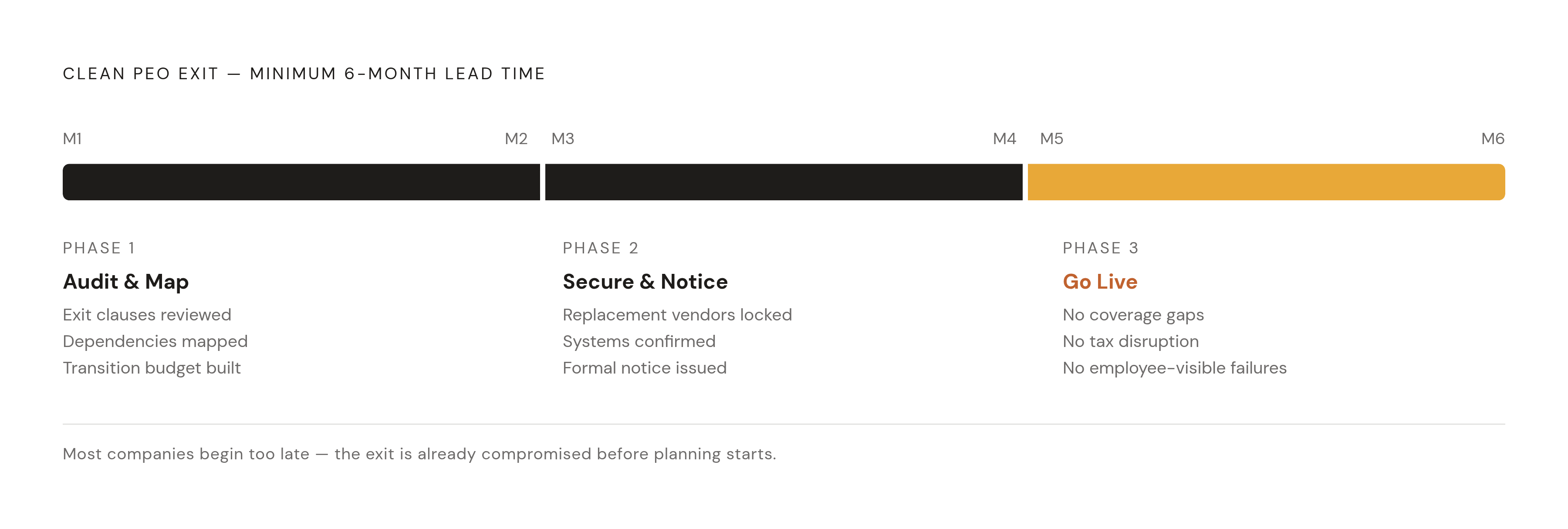
A clean PEO exit, one without coverage gaps, tax disruption, or failures employees can actually see, takes a minimum of six months to plan. Moving from a PEO to in-house infrastructure, or to a new provider, is a project with sequencing, dependencies, and a real budget behind it.
A structured timeline for that work breaks into three phases. Months one and two go toward building an accurate map of the current state: auditing the current contract for all exit-relevant clauses, identifying all payroll, benefits, workers' comp, and data dependencies, and producing a real budget that accounts for transition costs, run-out obligations, and the cost of standing up replacement infrastructure. Months three and four lock in replacement vendors and systems and issue formal notice.
Every clause examined earlier in this piece, the auto-renewal trap, the notice period's interaction with the billing cycle, the early termination fee, the benefits and workers' comp run-out, the data return terms, feeds directly into this timeline. None of it can be sequenced correctly without knowing, months in advance, exactly what the contract requires and by when.
Sources
- How To Cancel Peo Contract: Complete Exit Guide 2026
- Leaving Peo Mid Contract: Your Complete Exit Guide
- PEO Exit Strategy: A Step-by-Step Playbook for 2026
- PEO Termination: Notice Clauses That Decide What Leaving Costs | Peolet
- Peo Contract Termination Disputes: Resolution Guide
- Peo Termination Clause Legal Analysis: Owner's Guide
- PEO Q4 Renewal Trap: How Auto-Renewal Costs You 90 Days of Leverage | LeavePEO.com
- What to Look For in a PEO Contract Before You Sign | PEO Benefit Partners