EIN Reinstatement and State Tax Registration After Leaving a PEO
Companies leaving a PEO must reactivate their original EIN and re-register in every state.

A company inside a PEO arrangement does not run payroll under its own federal and state tax identifiers. It runs under the PEO's. This is the structural fact of co-employment: the PEO is the filing entity of record for employment taxes, unemployment insurance, and the related state accounts that accumulate over the life of the engagement. The IRS and state agencies see the PEO as the employer during that period, not the client company, regardless of who hired the worker, who sets the salary, or whose logo appears on the offer letter. That single fact means leaving a PEO is a tax-identity transfer, and every obligation that the PEO quietly carried, from depositing FICA withholding to maintaining a state unemployment insurance account with its own experience rating, reverts to the company the moment the relationship ends, with the company taking on full responsibility for employment taxes, including state unemployment insurance, from the cutover date forward.
What your EIN is after years inside a PEO, and what "reactivating" it means
Many operators assume they need a new EIN to run payroll independently, but they don't. The task is to reactivate the company's own EIN for payroll purposes, not to apply for a new one, because the IRS does not revoke or reassign EINs. An EIN is a permanent federal record tied to the entity that was issued it, and it remains associated with that entity through any period of dormancy, including years spent filing payroll under a PEO's tax ID while dormant. When the company leaves the PEO, it files taxes under the same federal EIN it has held since formation.
One exception matters, and it is narrow. If the company exits the PEO model by forming an entirely new legal entity, a new EIN is required, but that requirement follows from the creation of a new legal person, not from any expiration or cancellation of the old number. For the large majority of companies leaving a PEO without restructuring the business itself, the original EIN simply resumes active duty.
In practice, reactivating the EIN means notifying the payroll provider and every applicable state agency that this number is now the filing entity for payroll. It is an administrative and registration step, not a new application to the IRS. That distinction matters because the company should locate its original IRS CP 575 assignment notice, the letter issued when the EIN was first assigned, or request a 147C verification letter if that original notice has been lost over years inside the PEO relationship. Every downstream registration that follows, state tax accounts, payroll processor onboarding, bank verification, depends on being able to produce documented proof of that number before the cutover begins.
Why mid-year exit is the most expensive mistake operators make, and when to time the cutover
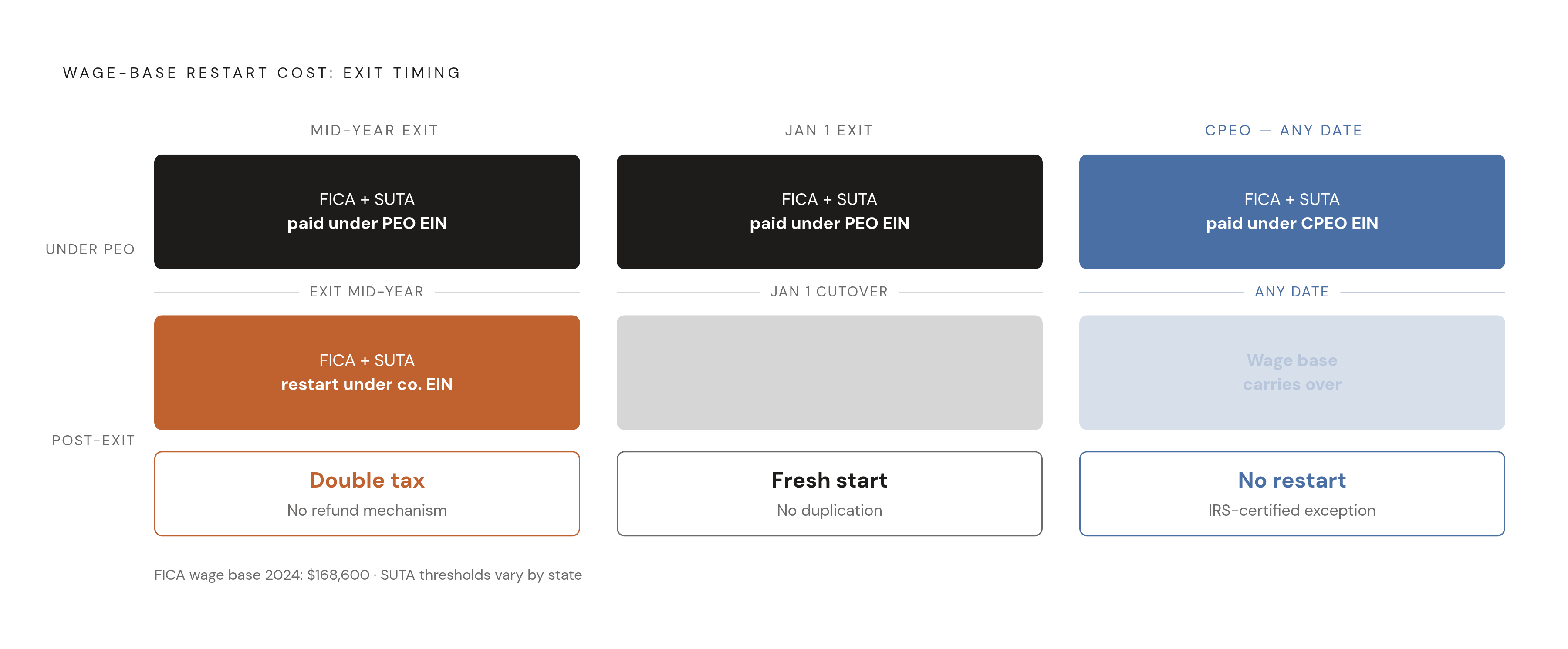
Timing the exit incorrectly is the most expensive error a company can make in this process, and the mechanism behind that cost is specific. A mid-year PEO exit resets the FICA and SUTA taxable wage bases for every employee on the company's payroll. Both the company and its employees end up effectively paying those taxes twice on wages that were already taxed once under the PEO's EIN earlier in the same calendar year.
The consequence lands differently depending on which side of the paycheck is affected. Employees receive two W-2s at year end, one from the PEO covering wages paid before the cutover and one from the company covering wages paid after it. Any excess Social Security tax withheld as a result of that split gets refunded to the employee when they file their individual return, so the aggregate tax burden on the employee side is neutral, even though the employee faces a short-term cash-flow disadvantage from the double withholding in the meantime.
The employer side carries no such refund. After exit, the company files under its own EIN and loses the benefit of employer-side taxes it already paid indirectly through the PEO earlier in the year. Those payments do not follow the company into its new filing status, and the employer must pay its share of FICA and SUTA again on the same wages, with no mechanism to recover the amount paid twice.
A Certified PEO changes this calculus. A CPEO, a PEO that holds IRS certification, eliminates the wage-base restart for customers who join or leave mid-year. Clients of a CPEO can avoid the double-taxation problem without waiting until January, potentially saving thousands of dollars depending on headcount and payroll size. Confirming whether the current PEO holds CPEO status should be the first step in any timing analysis, and that status can be verified against the IRS's public CPEO listing.
Benefits timing adds a second constraint on top of the tax calendar. Employee deductibles and FSA balances are tied to the plan year, and an exit that falls mid-year can disrupt coverage continuity and reset deductibles employees have already accumulated, compounding the financial cost of a poorly timed cutover on top of the wage-base problem already described.
The exact sequence of steps to reactivate your EIN and re-register in every state where you have employees
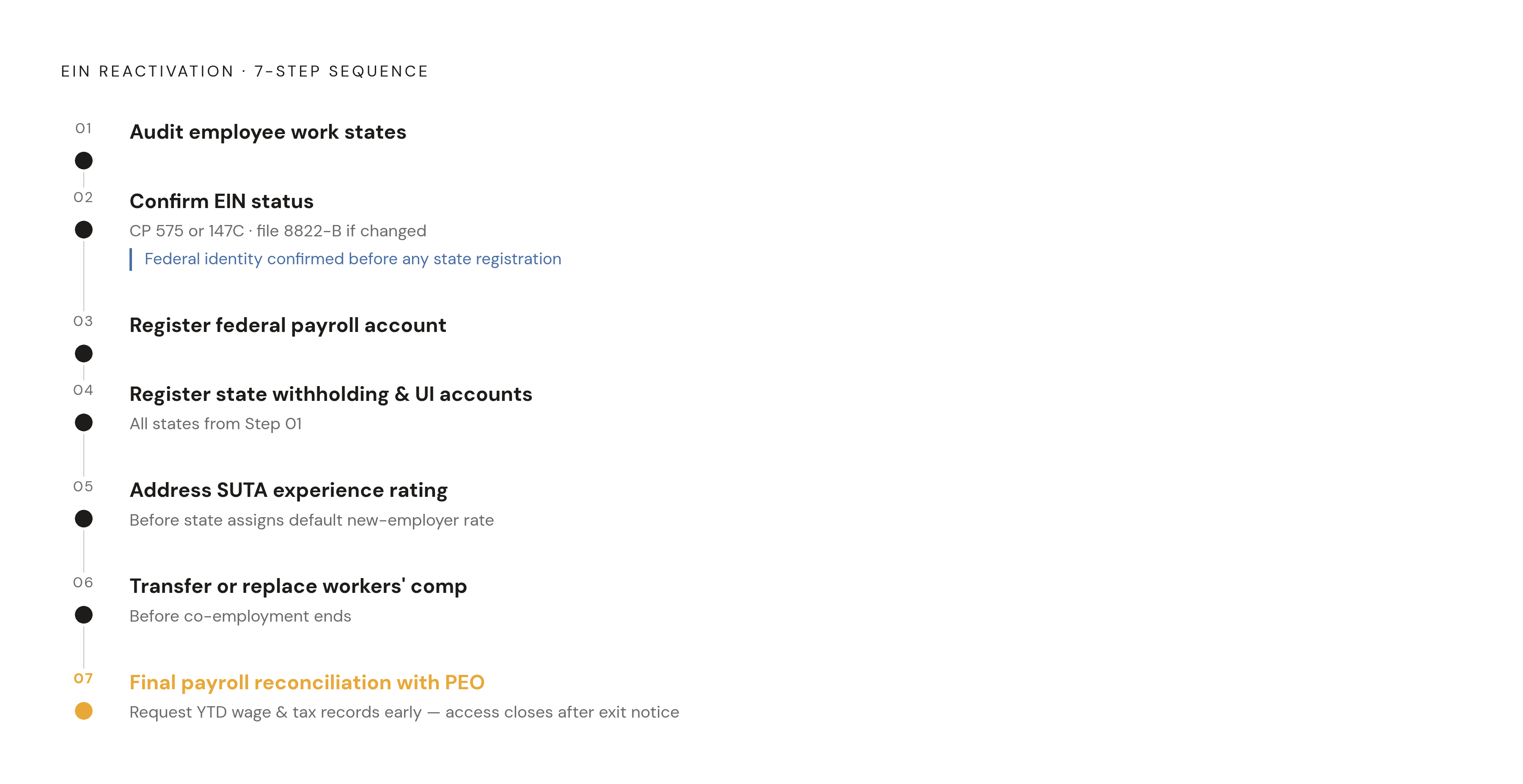
The sequence that follows is not arbitrary, and each step depends on the one before it: federal identity has to be confirmed before any state registration can proceed, and every state registration has to be complete before the company runs its first independent payroll.
The first step is a complete audit of every state where employees actually work, conducted before anything else begins. Missing a single state registration exposes the company to fees, penalties, or an outright bar on operating in that state until the gap is resolved, so the audit has to match each employee's actual work location, not their home address and not the company's corporate headquarters, to a specific state registration obligation. Remote employees create tax nexus in whatever state they physically work from regardless of where the company itself is incorporated, and a PEO running payroll on the company's behalf never changed which states had the authority to tax that activity. It only delayed the company's direct exposure to it.
The second step is confirming EIN status and assembling documentation before any state or payroll-processor work begins. That means locating the CP 575 assignment notice or requesting a 147C letter from the IRS, and it means confirming that the responsible party and mailing address on file with the IRS are current. If either has changed over the years inside the PEO, Form 8822-B should be filed: promptly, as a matter of IRS regulation, for a change in responsible party, and promptly as a strongly recommended practice, though not a mandatory one, for a change in mailing address, so that IRS correspondence reaches the right desk.
The third step is registering for a federal employer payroll account under the company's own EIN with its payroll provider. The company needs its EIN confirmed and a clear plan for how tax withholdings, filings, and remittances will be managed before it runs its first independent payroll. Concretely, this means configuring the payroll system to deposit FICA, FUTA, and income tax withholding under the company's own EIN, with no transitional arrangement routing any of it back through the PEO.
The fourth step is registering for state withholding and unemployment insurance accounts in every state the Step 1 audit identified. The company should not assume that a registration from before it joined the PEO is still active. Many states require re-registration or reactivation after an account has sat dormant for an extended period, and skipping that step is one of the more common gaps, one that becomes visible only when the first independent payroll run fails to process correctly.
The fifth step is addressing the SUTA experience rating before the state defaults the company into a new-employer rate. If unemployment claims were filed under the PEO's master account during the engagement, the company may have lost the independent experience rating it built up before joining the PEO, and some states will assign the default new-employer rate upon re-registration unless the company intervenes. Certain states have successor liability rules that preserve experience rating continuity, but using them requires filing specific forms within tight deadlines and often requires direct coordination between the company and the state agency. The company should request claims history documentation from the PEO before the exit date, not after, since that documentation is what supports a continuity argument with the state.
The sixth step is transferring or replacing workers' compensation coverage. If the PEO provided that coverage during the engagement, the company must secure a new policy that satisfies state requirements before the co-employment relationship formally ends, since workers' compensation is state-regulated and even a brief coverage gap can expose the employer to personal liability.
The seventh and final step is running a final payroll reconciliation with the PEO before the cutover date. The company needs year-to-date wage and tax records for every employee from the PEO, both to configure the new payroll system correctly and to issue accurate W-2s at year end. Data access from a PEO tends to get harder, not easier, once the company has announced its intent to leave, so wage histories, deductible credit reports, and employee tax records should be requested as early as possible in the exit process rather than left until the final weeks before cutover.
Compliance obligations the company now owns directly once it is the employer of record
Completing the seven steps above does not close the file. It opens a new one. Once the company is the employer of record under its own EIN, the entire federal and state compliance stack that the PEO previously carried becomes the company's direct and ongoing obligation, not something shared with a third party any longer.
Applicable large employers face ACA obligations that the PEO may have absorbed quietly for years. The ACA requires ALEs to offer qualifying health coverage to full-time employees and their dependents or face IRS penalties, and the company must now track its own ALE status, manage its own 1094-C and 1095-C filings, and confirm that its health plan meets minimum value and affordability standards on its own, without the PEO's infrastructure handling the calculation in the background.
COBRA administration is now the company's responsibility wherever the plan covers 20 or more employees in the prior year. The notice obligation is strict and procedural: once the employer notifies the plan of a qualifying event, the plan administrator has 14 days to send the COBRA election notice, and failure to meet that window carries a penalty. During open enrollment, the company must extend the same enrollment rights to COBRA-qualified beneficiaries that it extends to active employees, an obligation that newly independent employers frequently miss in the first enrollment cycle after exit.
ERISA recordkeeping and Form 5500 filing move onto the company's books as well. Best practice under ERISA is to retain plan documents for eight years, and any change in plan design or cost now has to be communicated through an updated Summary Plan Description or a Summary of Material Modifications, communication that the PEO previously handled on the company's behalf without the company needing to manage the drafting or distribution itself.
None of this ends at the state line either. Each state where the company has employees carries its own ongoing wage-and-hour rules, leave requirements, and reporting obligations that continue well past the registration date, and the company now has to monitor all of it directly, on a continuing basis, rather than treating the completed registration as the end of the obligation.