PEO vs. AI-Native Broker Total Cost Comparison
PEO costs hide behind admin fees while broker models reveal true total expenses.

Most operators comparing a PEO to a broker are comparing the wrong numbers. They get a PEO quote with a clean per-employee-per-month fee attached to it, and they get a broker pitch that talks about plan design and service, and they try to weigh one against the other as if the PEPM figure tells the whole story, but that figure leaves out everything that happens behind it. Behind that quoted administrative fee sit several more layers: payroll taxes and workers' compensation, the employer and employee share of benefits premiums, setup charges, state-specific add-ons, and the costs of eventually leaving, none of which appear in the number a PEO sales rep leads with. That means the real comparison was never PEPM against nothing, but PEPM against the difference in what the two models actually deliver on benefits cost, compliance, and service.
Stacking every cost layer for a like-for-like comparison
A fair comparison needs five categories lined up side by side: the administrative or brokerage fee itself; payroll taxes and workers' compensation; insurance premiums, both the employer and employee share; setup charges, minimums, and add-ons; and the costs that shift with headcount, state footprint, or benefit elections. Under a PEO, the administrative fee is the most visible line item on the invoice, but it's often not the largest cost driver. Benefits plan design and the workers' comp rate in the PEO's master policy usually move the total more than the admin fee does. Small business PEO pricing typically runs $1,000 to $1,500 per employee per year, and that range excludes benefits premiums, which are the single biggest line item for most employers regardless of which model they use. The comparison only works if you build both stacks against the same employee census, the same state footprint, and the same benefit elections. A sample invoice from a PEO, not a sales deck, is the right place to start pulling those numbers.
Under the broker model, the equivalent stack looks different. The brokerage fee to the employer is zero. The employer negotiates and owns its own benefits premiums, workers' comp, and payroll taxes directly, and there are no setup or exit fees tied to the HR relationship itself. AI-native brokerages like Spine build on that structure: they layer compliance automation and around-the-clock employee support on top of the employer's existing HRIS, so service stays deep while the employer keeps direct control of plan design and carrier relationships. Stacking these categories side by side shows that the strongest case for staying in a PEO isn't the admin fee at all, and the benefits pooling advantage deserves to be taken seriously on its own terms.
Where the PEO wins: benefits pooling for small headcounts
If a company has under roughly 50 employees, the PEO's large-group insurance pool is a real cost advantage that often outweighs the administrative fee. A small startup buying health insurance on its own gets classified as a small-group buyer in most states, which brings a narrower set of carrier options, fewer plan designs to choose from, and premiums that can jump sharply after a single bad claims year. Inside a PEO's pool, that startup is riding on the claims experience of thousands of other employees instead of its own, and the savings on medical premiums alone can, for a small team, exceed the PEO's entire service fee. Viewed in isolation, the admin fee looks like pure overhead. Viewed against what small-group insurance would otherwise cost, it often nets out lower.
The advantage doesn't stop at medical coverage. A PEO bundles 401(k) access without separate setup costs, workers' comp on a pay-as-you-go basis instead of a large upfront deposit, and basic compliance infrastructure, and each of those pieces carries real standalone cost if a company has to assemble them on its own. A startup competing for engineers against better-funded companies can close offers faster when it can put a national-carrier PPO, a 401(k) with match, and dental and vision coverage on the offer letter from day one. For a company at this stage, the PEO is the right answer, not a compromise. The pooling advantage is the PEO's strongest, most concrete value, and a serious cost comparison has to credit that.
Why the pooling advantage erodes as headcount grows
The same pooling structure that makes a PEO the right choice at low headcount is what eventually traps a growing company in an arrangement that costs more than it delivers. As a company hires, it builds its own claims history and its own negotiating leverage with carriers. The data that once made it too small to negotiate directly is the same data that, past a certain point, makes it large enough to do so. But inside a PEO, that leverage stays with the PEO, not the employer, because the PEO owns the pool and the relationship with the carrier. The company's own growth doesn't translate into its own bargaining power as long as it stays inside that structure.
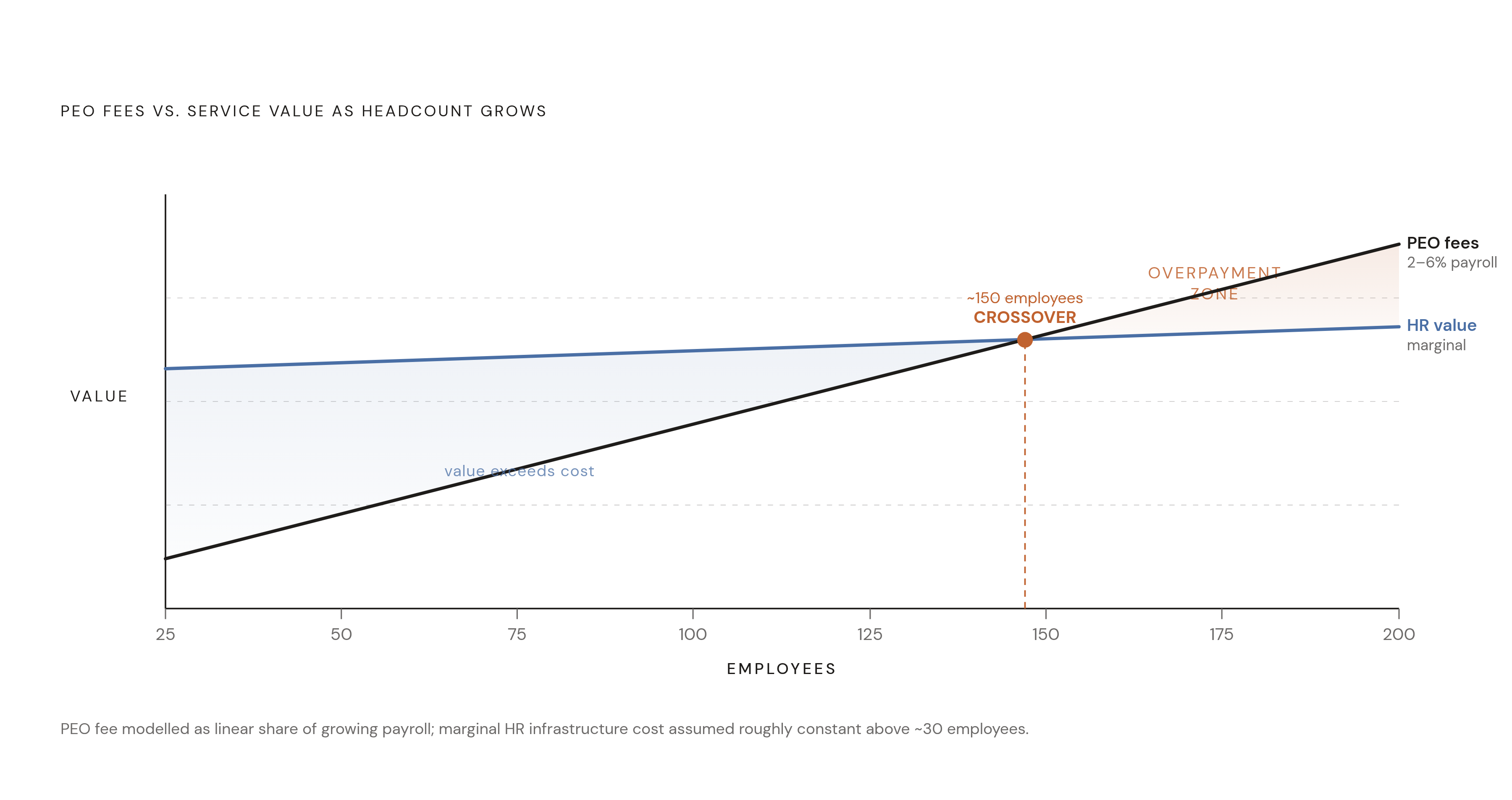
There's a structural cost that compounds as headcount rises. A PEO's PEPM or percentage-of-payroll fee typically runs 2 to 6 percent of payroll, and that fee grows proportionally with headcount and salary levels. The marginal service value delivered per additional employee doesn't grow at the same rate: the compliance and HR infrastructure a PEO provides costs the employer roughly the same whether the company has a few dozen employees or twice that number. Fees scale with payroll. The underlying service doesn't scale with it the same way.
On top of that, you lose FICA savings, a specific, often overlooked cost. In a standard PEO arrangement, the PEO is the employer of record and often retains the employer FICA savings on pre-tax benefit contributions, though this point can sometimes be negotiated into the contract. In a direct employment model, those savings accrue to the company instead. Once a company accumulates its own claims history and negotiating leverage, staying in a PEO means forfeiting both to the pooled model, while a brokerage approach, especially one built on AI-driven plan analysis and real-time compliance monitoring across jurisdictions, lets the employer capture that leverage directly and put it back into better plan design. None of this depends on hitting a specific headcount number like 100 or 200 employees. The crossover point depends on a company's state footprint, its salary levels, and its growth rate. It's calculable for any given company, even though it isn't the same number for every company.
The hidden costs of staying in a PEO too long
These costs materialize at the point of leaving, so they belong in the decision from the start.
Exit and transition costs run higher than most businesses expect going in. If you switch PEO providers, you pay termination fees and benefits transition costs, face new carrier underwriting, and lose time to a transition that typically takes four to six months. A company planning its exit needs to budget for that window the same way it budgeted for onboarding.
The mid-year tax trap is the cost most often missed. If you leave a non-certified PEO partway through the year, it can force a reset of the FUTA and SUTA wage bases, so the employer effectively pays those payroll taxes twice for the same year. That exposure compounds when companies are already dealing with small-group health insurance premiums that can spike 15 to 30 percent after one bad claims year. IRS-certified PEOs, known as CPEOs, carry tax liability protections that non-certified PEOs don't, and when you exit one, the wage base carries over. CPEO status matters for more than tax treatment during the relationship: it's a real signal of exit economics. If a PEO isn't certified, the IRS can hold the client company liable for unpaid employment taxes, including penalties and interest, no matter what the PEO's contract says about who's responsible.
Forfeited carrier leverage closes out the list. A company that has grown its workforce and built a favorable claims history inside a PEO's pool can't bring that history to a direct carrier negotiation, because the PEO owns the relationship, not the employer. When the company eventually exits, it re-enters the insurance market as a new small-group buyer, often at worse rates than its actual risk profile would justify. Some of these costs are one-time events tied to the act of leaving, while PEO fees are recurring charges billed every month. That distinction doesn't make the exit costs less important. It makes the decision to delay more expensive the longer a company waits, since the recurring fees and the forfeited leverage keep accumulating while the one-time exit costs sit there waiting to be paid eventually anyway.
How the AI-native broker model changes the cost structure
An AI-native brokerage automates the routine work that has historically made smaller accounts unprofitable for traditional brokers to serve closely, and that changes the economics of benefits service for small and mid-size employers. Traditional brokerage economics ration service by account size. A licensed broker's time is finite, and accounts generating lower premiums get less of that time. Small employers often get a plan placed once a year and hear little from their broker between renewals.
AI changes that math. Tasks that once took substantial manual work per plan, such as extracting data from Summary of Benefits and Coverage documents, running comparisons across carriers, and tracking regulatory changes across jurisdictions, can now be completed in a fraction of the time and with greater accuracy. That lets a smaller team serve more accounts at a higher standard of service than the traditional model allowed. The employer's cost stays at zero through all of this: an AI-native broker is still paid by the carrier, exactly as a traditional broker is, so the upgrade in service doesn't add a new line item to the employer's cost stack. What the employer gains in exchange is annual plan benchmarking against current market rates instead of last year's renewal rolled forward, automated compliance monitoring across federal and state jurisdictions, and employee support that doesn't depend on a broker being available to pick up the phone during business hours.
Spine's broker model for tech companies outgrowing a PEO
Spine is an AI-native benefits brokerage and HR operations platform built for startups and growing companies navigating the move away from a PEO, or weighing alternatives to a traditional broker relationship. The cost to the employer is none: Spine is paid by carriers, the way a traditional broker is, so the service doesn't add a PEPM fee, a percentage of payroll, or a setup charge to the employer's cost stack.
What Spine handles inside a single relationship covers most of what a growing company needs once it outgrows a PEO's pooled structure. On the benefits side, it designs health insurance plans and benchmarks them against current carrier pricing every year, using AI to analyze workforce data and carrier rates together instead of defaulting to whatever was in place the prior year. On compliance, it provides continuous monitoring, not an annual check-in, across a large number of federal, state, and local jurisdictions, covering ACA, ERISA, COBRA, Form 5500, and multi-state payroll obligations. On operations, it layers payroll workflow support and benefits administration on top of whatever HRIS the company already runs, so there's no platform switch required to get the service. On the employee side, support runs through a companion app called Heal, so employees get around-the-clock access to benefits guidance instead of a PDF and an 800 number that only gets answered during open enrollment. Spine also connects companies to a network of more than 50 vetted fractional CFO and HR practitioners for needs that go beyond benefits and payroll.
The co-employment question is where Spine differs most from a PEO. Spine is not a PEO: the employer keeps full employment status and full negotiating leverage with carriers. That means the company builds its own claims history from day one and can negotiate directly as it scales, instead of staying pooled indefinitely and forfeiting that leverage the way it would under a PEO arrangement.
Other models worth evaluating before the decision
If a company hasn't reached its crossover point yet, a well-run PEO is still the right choice. The pooling advantage is real at small headcounts, and the compliance bundling takes work off an early-stage team's plate that it couldn't otherwise staff. Anyone evaluating a PEO should press on three questions before signing: whether the provider holds CPEO status, since that affects both tax liability and exit economics; what the all-in rate actually includes beyond the quoted PEPM; and what the written exit terms say, in detail, before a contract gets signed.
A handful of adjacent models fill the space alongside the PEO and the pure broker, starting with Deel, which runs a PEO offering that covers US-team management across all states with automated compliance checks, full tax filing coverage, access to a wide range of benefit plans, and a unified platform for payroll and HR admin. It also lets companies stay with their current broker or benefits provider while Deel handles the administrative layer, a useful option for a company that's mid-transition and not ready to change every piece of its HR stack at once.
The administrative services organization model, or ASO, sits between a PEO and a pure broker. The employer keeps full employment status and buys benefits in its own name, but it outsources payroll administration and HR support to the ASO. A company can model this if it wants compliance and administrative support without entering co-employment, but isn't ready for a full benefits brokerage relationship yet.
Traditional brokers still work for companies that have established carrier relationships and enough in-house HR capacity to manage renewals on their own. The limitation is structural rather than a matter of individual broker quality: a commission model that doesn't reward annual renegotiation is less likely to surface cost reduction opportunities on its own. The employer must ask the right questions every year on its own initiative.