Worker Classification Risks During a PEO-to-Direct Transition
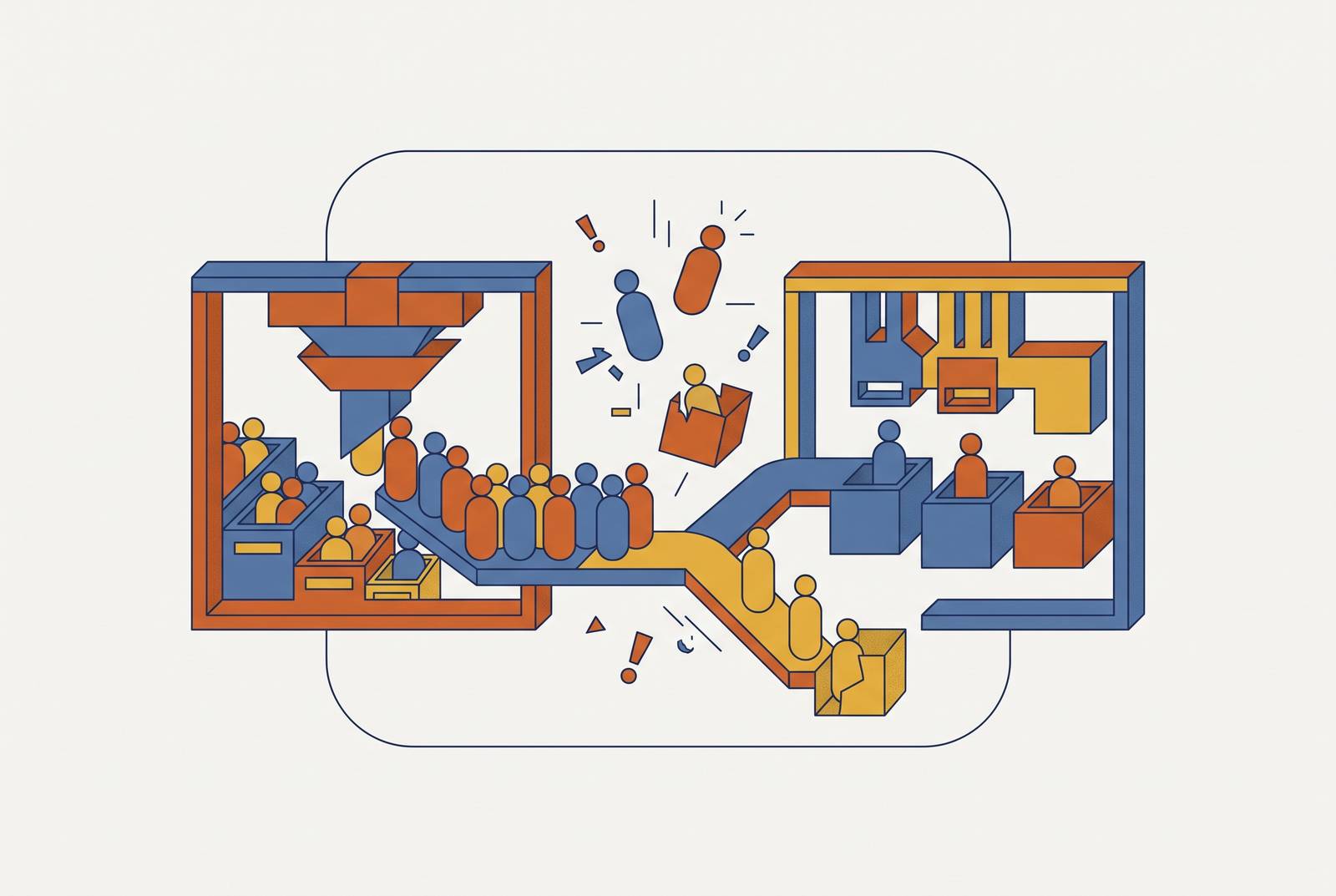
Leaving a PEO does not just change who cuts the paychecks. It forces a company to take formal ownership, for the first time, of classification decisions that co-employment quietly carried for years, and that handoff creates specific legal and tax exposure that grows with every worker whose status was never independently checked. A fast-growing company exiting a PEO at some meaningful headcount needs a plan for this before day one of direct employment, not after an agency letter arrives.
How co-employment handles classification decisions companies never formally make
A PEO arrangement splits employment into two roles. The PEO holds employer-of-record status for payroll tax filing and benefits administration, but the client company stays the common law employer for most other purposes, including day-to-day direction of the work. The PEO's administrative umbrella absorbs a long list of classification decisions into its operating workflow instead of those decisions being made, on the record, by the company itself.
The PEO files payroll taxes, it issues W-2s, and it runs benefits enrollment. Because those tasks move through the PEO's systems, the client company rarely has to state, defend, or even write down its own reasoning for how a given worker is classified. The work gets done. The logic behind it stays implicit.
This arrangement rests on two separate classification questions, and they get mixed together constantly. One is whether a worker counts as an employee or an independent contractor. The other, which only applies once someone is confirmed as an employee, is whether that employee is exempt or non-exempt from overtime. A PEO's administrative umbrella can obscure both at once, because payroll runs smoothly either way. Salary and job title don't settle whether an employee is exempt from overtime. The correct answer requires meeting a compensation threshold and passing a duties test tied to what the person actually does, not what their offer letter calls them, and that distinction tends to go unexamined when payroll is someone else's job to run correctly.
None of this reflects a company cutting corners. The client retains real operational control: hiring, performance management, termination decisions all sit with the company. What shifts to the PEO is the administrative execution, and that creates a structural gap between who manages the work day to day and who formally accounts for how that work is classified under the law.
What the transition moment transfers to the company
Exiting a PEO is the moment a company takes formal ownership of classification decisions that, under co-employment, may never have been independently validated by anyone.
Every worker who was administered under the PEO now needs the company to affirmatively establish and document its own classification basis: employee or contractor, exempt or non-exempt, and defensible under whatever federal and state tests apply. U.S. worker classification law looks at the substance of the actual working relationship, not the label the parties chose to put on paper. A contractor designation carried forward from the PEO era does not validate itself just because it's been in place for two years without incident.
The federal rule governing this question is itself in motion. The Department of Labor's 2024 independent contractor rule took effect March 11, 2024. On February 26, 2026, the DOL proposed replacing it with a new framework that would give more weight to two "core factors," in the agency's own language: the nature and degree of control over the work, and the worker's opportunity for profit or loss based on initiative and investment. That follows an earlier shift: in May 2025, the DOL issued Field Assistance Bulletin 2025-1, instructing investigators to apply the prior "economic realities" test. A company transitioning off a PEO needs to know which standard, and which controlling case law, actually governs at the moment its own transition happens. The rule in effect last year is not necessarily the rule in effect this quarter.
Because the federal standard keeps shifting, a classification review performed at exit cannot be treated as a permanent fix. It has to be anchored to whatever framework is actually operative when the review happens, with the understanding that another look may be needed if the rule changes again.
How the shifting federal standard changes the exit window
Even when federal enforcement turns more flexible, your misclassification exposure doesn't go away. It changes which test applies, but state standards, often tougher than the federal ones, stay fully in force no matter what the DOL decides.
Federal tax authorities run their own separate analysis, and they look at behavioral control, financial control, and what kind of relationship the parties have. That test is distinct from the DOL's wage-and-hour framework. A single company can face two federal standards at once, each one capable of reaching a different conclusion about the same worker. Issuing a Form 1099-NEC settles nothing on its own. If the underlying facts establish an employment relationship, tax authorities can assess unpaid taxes, interest, and penalties no matter how the relationship was labeled or reported on paper.
State law adds another layer. One state's strict worker-classification test, for instance, presumes a worker is an employee unless the hiring company can show the worker is free from its control, performs work outside its usual course of business, and is customarily engaged in an independently established trade. That standard is considerably harder to satisfy than many federal tests, and it means a classification that holds up under federal rules can still fail in a specific state. A single classification policy applied uniformly across a multistate workforce can be correct in one state and wrong in the next, simply because the tests don't match up.
If your company has workers outside its home state or country, remote work adds one more complication. Permanent establishment risk appears first in local payroll registration, wage tax withholding, and social security contributions, the kind of thing that lands on an HR team's desk before Finance ever identifies the underlying corporate tax exposure. A company exiting a PEO with a distributed workforce is taking on this layer at the same time it takes on everything else.
The specific exposures that attach when misclassification surfaces post-exit
Once a company becomes the direct employer of record, misclassification exposure is no longer shared with or cushioned by a co-employer. The full range of liability belongs to the company alone.
A misclassified worker can bring claims for unpaid minimum wage, unpaid overtime, expense reimbursement, and benefits or other statutory protections, depending on which state's law governs the relationship. Separately, the company can face liability for unpaid payroll taxes, unemployment insurance and workers' compensation contributions, interest, penalties, and in some cases liquidated damages and attorneys' fees. None of these categories are small individually, and a workforce where the same classification error repeats across many workers can see that liability compound across every affected employee and every year the error persisted, well before interest and penalties are layered on top.
Individual officers face their own exposure here, separate from the company's. If you collect and remit withheld income and employment taxes, and you willfully fail to do so, you can be held personally liable for the federal Trust Fund Recovery Penalty, and that includes officers and anyone with check-signing authority. The IRS has been explicit that this category includes corporate officers and agents with authority over the funds, and that willfulness includes choosing to pay other business expenses ahead of withholding taxes. Misclassification that turns out to be willful can trigger this personal exposure directly, and some states maintain comparable responsible-person penalties of their own.
The exposure doesn't stay contained to one worker or one agency. Federal and state labor departments and tax authorities can each pursue the same classification issue on their own, private litigants can bring related wage claims, and when a single classification model was applied across a workforce, liability can extend well past the one relationship that first drew attention. For companies anticipating a sale or other liquidity event, misclassification is also a red flag to buyers, who may respond with purchase price reductions, escrows, or indemnification demands to protect themselves against liabilities uncovered during diligence. That risk runs especially high for tech companies building toward an acquisition or other liquidity event, where a clean cap table and clean employment records both matter to the deal.
The structural fix: a classification audit before direct employment begins
The best time to address classification is before the company takes on direct employer-of-record status, not after a dispute or an agency inquiry forces a retroactive look back. An audit done ahead of the transition is a deliberate process on the company's own terms. A review triggered by a complaint or an investigation is a reactive one, done under scrutiny and often under a deadline the company didn't choose.
Each worker needs to be classified against the actual working relationship: what the person does day to day, how much control the company exercises, and how the work is structured. The two questions still need separate treatment. Confirming someone is properly a contractor doesn't resolve whether an employee down the hall is correctly exempt from overtime, and conflating the two is one of the more common errors that leaves wage-and-hour exposure sitting unaddressed even after the contractor status is resolved correctly.
Rushing this process defeats its purpose. Documenting the reasoning behind each classification call matters because that documentation becomes the company's evidence of a good-faith basis if the determination is challenged later, whether by a worker, a state agency, or the IRS. A classification can be defensible under federal law and still be wrong in a specific state, so if you have a multi-state workforce, each state with workers on the payroll needs its own analysis, mapped out before direct employment starts.
When a company exits a PEO and takes on direct employer-of-record status, it inherits the need to validate and document classification decisions that may never have been independently reviewed. Platforms like Spine layer compliance automation on top of the HRIS a company already runs, and they can audit worker classification across the entire workforce before day one of direct employment, so each worker's status gets mapped against the controlling federal and state tests in effect at that moment instead of carrying forward whatever assumptions came out of the PEO era.
The compliance obligations that activate simultaneously with direct employment
Classification is not the only thing that comes due at PEO exit. ACA reporting, ERISA filings, COBRA administration, and multi-state payroll registration all activate on the same timeline, and a gap in any one of them adds to the total exposure.
ACA compliance depends on correct measurement periods, proper offers of coverage to full-time employees, and accurate Forms 1094-C and 1095-C. The full-time employee determination that drives those obligations runs on the same logic that governs exempt status under wage-and-hour law, so one classification mistake can create a wage claim and an ACA reporting error at once. COBRA brings its own clock: general notices have to reach new plan participants within a set window after coverage starts, and election notices have to go out promptly after a qualifying event, with per-day, per-employee penalty exposure attached to a missed deadline.
Multi-state payroll runs on the general rule that tax follows where work is physically performed, though a worker's state of residence may also tax all of that income, and reciprocity agreements or convenience-of-the-employer rules can shift which state actually withholds. Hybrid schedules, short-term travel, and remote relocations can each trigger new withholding obligations, new unemployment insurance requirements, and local tax exposure that an audit often finds only after the fact.
State paid family and medical leave programs are expanding on their own separate timelines. Delaware's program began benefits January 1, 2026. Maine's benefits begin May 1, 2026. Maryland's program, originally expected around the same window, has been pushed back by a May 2025 amendment to contributions starting January 1, 2027 and benefits no later than January 3, 2028. When a multi-state employer brings payroll in-house, it has to map each of these obligations against its own workforce footprint at the moment the transition happens, not whenever convenient afterward.
Because classification tests operate independently across federal tax law, federal wage-and-hour law, and state law, each capable of reaching a different conclusion about the same worker, a transitioning company cannot treat a single validation pass as sufficient. Continuous compliance monitoring across jurisdictions, the kind that AI-native benefits platforms are built to automate, matters most during the PEO exit window, when classification decisions have to be documented defensibly under whichever federal standard governs at that exact moment, and then revisited if the standard shifts again.
How the right support structure at transition changes the risk profile
The exposure that appears at PEO exit is a reason to replace the co-employment structure with direct HR and benefits support built deliberately to handle the handoff.
A PEO makes sense at early headcount. It pools risk across many client companies, and it absorbs a layer of administrative complexity that a five-person HR team couldn't take on alone. But as a company grows past that early stage, the same co-employment structure that once provided cover turns into an overhead cost, and it limits the company's flexibility to design its own benefit plans, set its own exempt thresholds, or own its classification decisions directly.
A traditional broker fills part of the resulting gap, mainly on the benefits side, but doesn't touch payroll registration, classification audits, ACA reporting, or COBRA administration. The company still has to assemble those capabilities on its own, usually at real cost right at the moment of transition. An AI-native brokerage and HR operations platform, one that layers compliance monitoring, benefits design, and employee support on top of the HRIS the company already uses, treats the handoff as one connected discipline instead of a set of separate vendor relationships that someone has to stitch together by hand.
Spine's model is built around that structure: a dedicated consultant paired with AI-powered plan analysis, automated compliance monitoring across jurisdictions, and round-the-clock employee support through its Heal app. These are capabilities that stay with the company after the PEO relationship ends, with no co-employment lock-in and no per-employee fee attached. Because Spine gets paid by carriers the same way a traditional broker does, the service costs the employer nothing directly. A company can fund a genuine classification-and-compliance transition within the budget case it already built to justify leaving the PEO.
The question facing a growing company was never whether it would eventually take on direct employer responsibilities. Growth makes that outcome inevitable. Whether the company takes on direct employer responsibilities with infrastructure built specifically for that transition, or without it, is the real question.