Paid Family and Medical Leave Compliance Across Multiple States
Employers in 13 states now navigate vastly different PFML rules simultaneously.
Paid Family and Medical Leave Compliance Across Multiple States
Why PFML is no longer a single-state compliance problem
The FMLA guarantees up to 12 weeks of unpaid, job-protected leave, which is the entire federal contribution, and everything paid comes from state law Clockspot. As of 2026, that patchwork covers 13 jurisdictions, 12 states plus DC, paying partial wage replacement Clockspot.
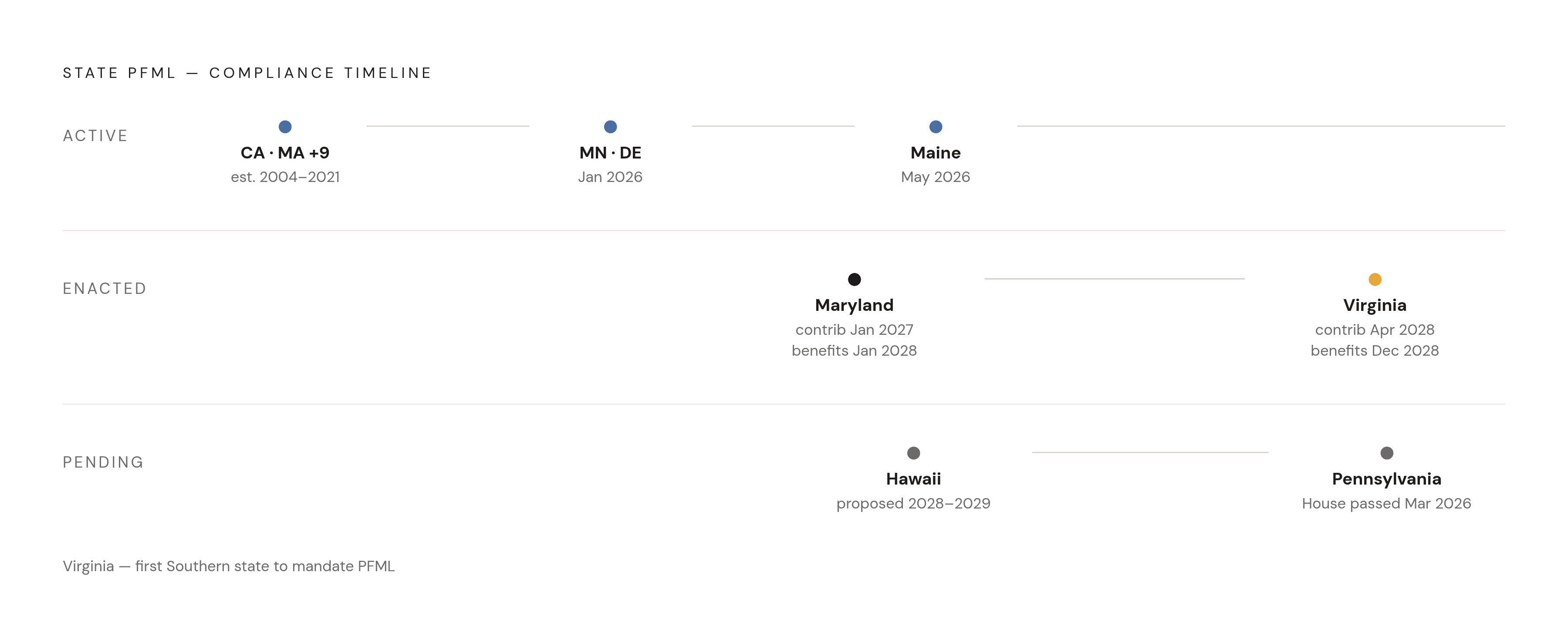
The pace of change is the part employers tend to underestimate. Three programs alone came online in the 2025 to 2026 window: Delaware started paying benefits January 1, 2026, Minnesota launched both contributions and benefits on the same date, and Maine began paying out May 1, 2026. Virginia signed a mandatory PFML law on May 11, 2026, becoming the first Southern state to do so, and even though contributions don't start until April 1, 2028, the signal is clear: this is no longer a coastal or blue-state phenomenon.
For a company with workers scattered across a handful of states, the practical reality is that the team is almost certainly operating under multiple, non-identical PFML regimes simultaneously. One might be earning benefits under a program that caps out at $900 a week. Another might be in a state paying out nearly double that. This isn't a matter of differing HR philosophies between states. Treating it otherwise is where the liability starts. 14 states and DC have enacted paid family leave laws covering maternity leave (Rippling's September 2026 guide). This should be framed as a structural shift, not a compliance nuisance: each state program is a social insurance system, closer in structure to unemployment insurance than to ordinary PTO policy
Why remote work makes triggering contribution obligations harder
The rule that governs almost everything downstream is simple to state and easy to get wrong in practice: PFML obligations follow where the employee actually works, not where the employer is incorporated or headquartered. Washington and Oregon both apply what's called a localization test, the same test used to determine unemployment insurance liability, meaning contributions are owed to the state where the work is physically performed.
Consider a company headquartered in Texas, a state with no PFML program of its own, that hires one remote employee who happens to live in Washington. That single hire creates a Washington PFML contribution obligation, regardless of the fact that the company has never had a payroll presence there before. The dangerous part is that this kind of gap often goes unnoticed until the employee actually files a benefit claim and the state agency finds no contribution history on record. By then, the employer is looking at back payments, interest, and an employee who isn't getting paid on time through no fault of their own.
The stakes vary by state in ways that matter operationally. Contribution rates for 2026 span from 0.4% of payroll in Delaware up to 1.3% in California, which has no wage cap on its contribution base Clockspot. Weekly benefit maximums swing even more widely, from $900 in Delaware to $1,765 in California. A single misconfigured payroll rule doesn't just affect one paycheck; it touches every check run through that system, and employees will notice fast if their state's program isn't properly funded on the employer side.
The irony for tech employers specifically is that distributed hiring, the very practice many companies market as a competitive advantage in recruiting, is the same mechanism that multiplies PFML exposure across states. Every remote hire in a new state is a new jurisdiction to track.
The 2026 state-by-state changes every multi-state employer must know
Minnesota's program launched contributions and benefits on the exact same day, January 1, 2026, the only state to do so. The program covers up to 20 weeks of combined family and medical leave, with wage replacement set at 90% of wages up to half the state's average weekly wage, then 50% above that threshold. Every employer with even one Minnesota employee must participate, though a private plan opt-out exists under state statute. The maximum weekly benefit is $1,423.
Employers with 25 or more workers may either deduct half (0.4%) of the contribution from employees or absorb the full 0.8% themselves. The threshold for full coverage is 25 or more employees, and the maximum weekly benefit is $900.
Maine's benefits begin May 1, 2026, while contributions began January 1, 2025. Coverage includes up to 12 weeks of leave for family care, medical needs, military exigency, service member care, and what the law calls safe leave. The mandate applies to private employers of all sizes, though full participation requirements kick in at 15 or more employees. Employers also carry a notice obligation: new hires must be told about their paid leave rights within 30 days, and mandated notices need to be posted where employees can see them. Maine's maximum weekly benefit is $1,199.
Washington raised its contribution rate by 23%, from 0.92% to 1.13%, effective January 1, 2026.
Colorado added something genuinely new to its FAMLI program: NICU leave. Employees whose infants need inpatient neonatal intensive care now qualify for an additional 12 weeks of paid benefits, stacked on top of the standard 12 weeks (plus 4 more for pregnancy complications), so a parent could be entitled to 28 weeks or more of total leave. That NICU leave is intermittent-only under regulations adopted effective January 1, 2026, and it doesn't reduce an employee's entitlement to other FAMLI leave types. Colorado's overall premium rate actually dropped slightly, from 0.9% to 0.88%.
Massachusetts continues to run one of the most generous programs in the country. Its maximum weekly benefit climbed to $1,230.39 for 2026, a $60 increase over the prior year, and the program allows up to 26 combined weeks of family and medical leave, the broadest duration among any active state program.
Clockspot's analysis shows that as of 2026, 13 jurisdictions (12 states plus DC) are paying partial-wage-replacement PFML benefits, and for any multi-state employer already juggling PFML compliance across them, additional state rules are one more thing to fold into the same tracking system.
Some programs are enacted but not yet paying out, which is its own category of risk because employers can mistake "not yet effective" for "not yet urgent." Maryland's contributions start January 1, 2027, with benefits following no later than January 3, 2028, at an initial rate of 0.90% and a maximum weekly benefit of $1,000. Virginia's contributions begin April 1, 2028, benefits begin December 1, 2028, at an estimated rate of 0.72%, though the final rate is subject to VEC rulemaking.
Two more states have legislation moving through the pipeline but not yet law. Hawaii's House Bill 755 would require contributions by January 1, 2028, and benefits by January 1, 2029, though this remains unconfirmed and pending. Neither should be treated as settled law, and both deserve close attention given how quickly Minnesota, Delaware, and Maine moved from enactment to active benefit payments.
Outside the mandatory-program map, two states run voluntary, state-sponsored insurance markets rather than social insurance funds. New Hampshire's Granite State Paid Family Leave has been underwritten by MetLife since January 2023, and Vermont's VT-FMLI has been underwritten by The Hartford since July 2023. Neither is mandatory, but both matter for employers designing benefits packages that need to compete with states that do mandate coverage. Code Ann. tit. 19, § 3711 Connecticut (January 1, 2026): Paid sick leave law expands to employers with 11 or more employees (not a PFML program, but an additional leave layer for multi-state employers) Pennsylvania Family Care Act (House Bill 200): bipartisan, passed by the full state House on March 25, 2026 (107–92) and advanced to the Senate (unconfirmed/pending)
The five operational mistakes that create the most PFML liability
Most of the liability employers actually incur doesn't come from ignorance of the law in the abstract. It comes from five recurring, specific operational failures.
The first mistake is applying headquarters-state rules to remote employees. A Texas employer with a Washington remote worker must remit Washington contributions under RCW 50A.10.020.
The second is failing to designate FMLA leave concurrently with PFML leave. Federal guidance in DOL Opinion Letter FMLA2025-01-A, dated January 14, 2025, makes clear that state PFML and federal FMLA run concurrently when both qualify. Employers are required to designate FMLA leave within five business days of learning about a qualifying reason. If that designation is skipped, the FMLA clock never starts, and an employee can exhaust their PFML benefit period and then claim a separate, additional block of unpaid FMLA leave on top of it. That's a substantive gap with real consequences. It's extra weeks of job-protected absence the employer didn't plan for.
The third mistake involves the private-plan opt-out that nine states allow: Massachusetts, New York, New Jersey, Washington, Oregon, Colorado, Delaware, Minnesota, and Maine. Each of these states runs its own approval process, its own re-approval cycle, and its own benefit-equivalence review, and none of those processes are interchangeable. If an approval lapses, or gets denied retroactively after an employer has already stopped paying into the state fund, the employer can end up owing contributions to the state and owing employees who paid into a plan that's no longer recognized, which amounts to paying twice for the same coverage.
The fourth mistake concerns the tax treatment of employer-paid contributions. IRS Notice 2026-6 extends transition relief through 2026, but that relief is temporary, and payroll systems need to reflect the correct treatment before it expires. Employers who pick up the employee's share without grossing up wages accordingly end up with W-2 reporting errors and wage-statement violations, neither of which is cheap to unwind after the fact.
The fifth mistake is applying one uniform leave policy across every state an employer operates in. State enforcement agencies are actively auditing leave compliance right now, particularly in states that enacted new or expanded programs in 2025 and 2026, and a single national policy can unknowingly violate a state's accrual minimums, carryover rules, or payout obligations without anyone at the company realizing it.
A sixth exposure doesn't appear on the standard list of mistakes. Laughlin v. 2026) held that PFMLA anti-retaliation protections reach the corporate employer but not individual board members, officers, agents, or investors. That distinction matters for how HR structures accountability internally, and it's a reminder that PFML-related adverse action needs the same level of caution any employer would apply to an FMLA retaliation claim. 2025-4 (January 15, 2025): when an employer pays some or all of an employee's required PFML contribution, that pick-up is treated as additional taxable wages, subject to federal income tax, FICA, and FUTA
Multi-state PFML's interaction with payroll registration, SUI, and broader compliance obligations
PFML contributions never arrive alone. Hiring a single employee in a new state triggers state income tax withholding registration and unemployment insurance setup at the same moment it triggers a PFML obligation, and all three run through the same payroll infrastructure. Get the location data wrong once, and the error propagates through every one of those systems simultaneously.
The threshold for triggering these obligations is lower than most employers expect, especially compared to something like sales tax nexus. Some states have no de minimis threshold at all, so a single day of work can create a filing obligation, while others use a 14-day or 30-day window. Physical presence isn't even a reliable guide anymore. New York's Tax Appeals Tribunal upheld in May 2025 that a law professor working entirely from his home in Connecticut for a New York City employer still triggered New York withholding under the state's convenience-of-the-employer rule, a doctrine that assigns tax liability based on whose convenience the remote arrangement serves, not where the desk physically sits.
SUI wage bases for 2026 illustrate just how uneven the underlying infrastructure is Clockspot. Washington also carries one of the highest PFML contribution rates in the country.
None of this happens in a vacuum separate from the rest of employment compliance. The 2026 landscape includes 19 minimum wage increases, 3 new PFML programs, 8 state income tax changes, and pay transparency laws now active in 17 states plus DC. Penalties for getting this wrong aren't trivial either; violations can reach $250,000 in some jurisdictions, and that figure shows this is not a soft compliance risk. States are using AI to detect payroll inconsistencies, making accurate location tracking essential, since the same data hygiene that prevents payroll mismatches also prevents PFML contribution errors.
Reciprocity agreements add one more wrinkle that trips up otherwise careful employers. These agreements, which exist between certain neighboring states to prevent double income tax withholding, do not extend to PFML. An employee who's exempt from income tax withholding in their home state under a reciprocity deal is not automatically exempt from PFML contributions in the state where they physically work. Treating the two as equivalent is a mistake that appears in state audits with some regularity.
What a functioning PFML compliance operation looks like
PFML compliance is a recurring operational discipline. It's a recurring operational discipline, one that breaks down into at least four distinct process streams that need to run continuously, not just at year-end or during a benefits renewal cycle.
The first stream is jurisdictional monitoring. That means keeping a live, current map of every state where employees are actually performing work, distinct from the states listed on personnel files or org charts. It also means tracking programs that are enacted but not yet paying benefits, Maryland's 2027 start and Virginia's 2028 start being the clearest examples, on a forward calendar rather than waiting for the effective date to arrive. Contribution setups take real time to configure correctly, and waiting until a program goes live all but guarantees a late start. The same monitoring discipline should extend to pending legislation in Hawaii and Pennsylvania, both of which serve as early indicators of where the next wave of state programs is headed.
The second stream is payroll and contribution mechanics themselves. For every state where an employer has established nexus, that means registering with the state's revenue department and its unemployment agency, securing the correct withholding and SUI account numbers, and setting up a deposit schedule that matches what each state requires. Registration timelines aren't uniform either; some states process registrations in a matter of days, others take considerably longer, and an employer that waits until a new hire's first paycheck is due to start that process is already behind.
Get both streams running well, and PFML stops functioning as a source of surprise liability: it becomes a predictable, well-funded safety net for workers, backed by an employer that knows what it owes, to whom, and when.
Sources
- Paid Family and Medical Leave by State: 2026 PFML Rules | Clockspot
- State paid family leave benefit changes in 2026 | HR Dive
- State Leave Laws Continue to Expand in 2026: What Multistate Employers Should Know | Womble Bond Dickinson
- Five Common PFML Pitfalls—And How to Avoid Them | Employment Law Letter
- Liability Under Massachusetts Paid Family and Medical Leave | Littler
- 47 State-Specific HR Compliance Changes for 2026 | SPARK Blog | ADP
- State PFML Changes Pressure Payroll in 2026