Open Enrollment Communication Timeline for Remote-First Companies
Distributed teams need a four-to-six-week campaign, not last-minute announcements.
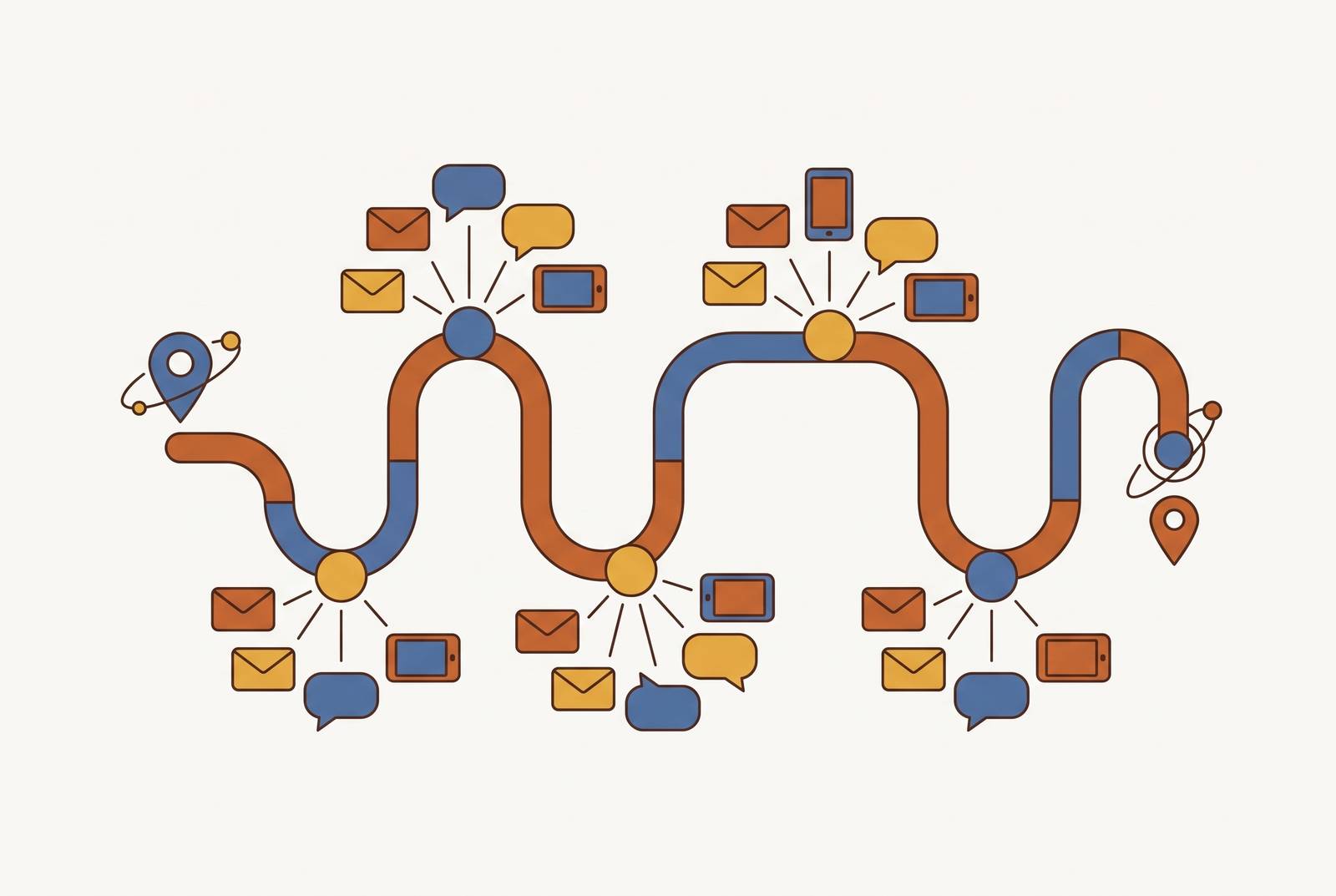
Open enrollment communication for remote-first companies must be a phased, multi-channel campaign. Starting 4–6 weeks before the window opens gives employees time to understand their choices and gives HR time to resolve problems before deadlines become urgent. The timeline must account for time zones, household decisions, state requirements, and the work of turning completed elections into usable benefits.
Why open enrollment is harder to run at a distributed company than most HR teams expect
There are no hallway conversations, office posters, or in-person benefits fairs to reinforce a message employees missed. Async communication also makes an urgent enrollment notice compete with messages that can wait. Without a shared time zone, even a deadline requires more explanation than a calendar date.
A multi-state workforce adds another complication because employees may face different external deadlines when coordinating employer coverage with a state exchange. That makes one published date an incomplete guide for some employees. The short election period leaves little time to clear up that confusion. International Foundation of Employee Benefit Plans findings indicate that a majority of employers use a two-week period, with three- and four-week windows also common.
LIMRA enrollment findings show that only about one in three eligible workers enroll in or change benefits when offered an enrollment period. That figure establishes the engagement challenge before distributed-work friction enters the picture. The financial stakes are substantial because health coverage is typically the largest budget line after payroll. Elections and defaults commit both employer and employee spending for the full plan year.
Why the solution is a phased campaign starting 4–6 weeks before the window opens, not a launch-day announcement
The active election window should function as a decision sprint. Employees need plan comparisons and education, and managers need briefings, before the portal opens. The live period can then focus on reminders, follow-up questions, and completion tracking. When education and elections start together, employees must learn as the deadline approaches while HR deals with questions and technical problems at the same time.
Phasing separates work that otherwise competes for the same limited attention. Awareness establishes what is coming, education explains the choices, and decision support helps employees act. Urgency helps employees act only after that groundwork is in place, while post-close activation helps them use what they chose. Collapsing these purposes into one announcement weakens each of them.
Employees who miss one channel can encounter the next touchpoint, and those in different time zones can review materials before the deadline dominates their attention. Meanwhile, HR can complete carrier confirmations and platform testing when there is still time to fix problems. Early preparation shifts difficult work out of the period least able to absorb it.
Six to four weeks out: confirming what is actually changing and building the communication infrastructure
The first phase is internal because employee messages are only as reliable as the information behind them. Before communication begins, finalize plan options, rates, employee contribution amounts, and design changes. Translate those details into a one-page, side-by-side comparison designed for decisions. It should show per-paycheck costs by coverage tier, deductibles, out-of-pocket maximums, copay structures, network types, prescription costs, and HSA eligibility.
That comparison becomes the foundation for later messages, so discrepancies matter now. If an employee contribution amount remains unresolved, the amount communicated could differ from the amount used for payroll deductions. Discovering that mismatch after enrollment closes would leave HR reconciling a decision made on inconsistent information.
Platform readiness requires more than an HR walkthrough. Before the window opens, test how employees will use the platform, including mobile access and access without corporate VPN credentials. The test should account for employees and those who help make coverage decisions at home reviewing coverage on their own devices outside business hours.
Managers also need a short response guide for common questions so that they do not improvise answers. Complete that briefing packet and the plan comparison before week four. With the information settled and the platform tested, send a save-the-date message explaining what is coming, when enrollment opens, and where resources will be available.
Four to two weeks out: education that reaches employees where they actually are, not where HR assumes they are
Education should begin with a plain-language explanation of what is changing. The full Summary of Benefits and Coverage serves a different purpose from a short explanation of this year’s differences in paycheck deductions and care access. Employees need the latter to understand why the changes matter before working through the details. Cost scenarios can then connect plan features to familiar decisions, including coverage for someone who is generally healthy, managing a chronic condition, or expecting a baby.
These scenarios make the comparison more useful than definitions alone. Explaining coinsurance does not do the same job as showing how the available plans differ for a particular care situation. Total compensation statements add another dimension by showing the employer’s full investment. Together, these materials present coverage as part of compensation and as a practical choice about costs and care.
Email holds the detailed comparisons, scenarios, and step-by-step instructions employees may need to revisit. Slack or Teams gives employees short nudges to take one action, with links to those materials to keep the details in one place. A recorded enrollment presentation gives employees in every time zone access without requiring attendance at a session scheduled for one region.
At least one live virtual Q&A session should also be held and recorded. It gives employees who have reviewed the materials a chance to resolve questions, while the recording makes the answers available asynchronously. Enrollment education should include household-facing content because a spouse or another household member may help make the coverage decision.
During the active window: a day-by-day cadence that maintains momentum without overwhelming employees
When the portal opens, the communication goal changes from understanding to completion. The opening message should have one obvious call to action, which is to enroll now. Supporting content should help employees take that action rather than introduce plan information they have not seen. A live completion dashboard lets HR track progress and see which employees still need help.
At the midpoint, roughly day 5–7 of a two-week window, send a progress reminder. Include how many employees have completed enrollment, answers to the leading questions HR has received, and the office hours schedule for the remaining days. This message combines a prompt with practical support instead of merely repeating the launch notice. It also makes the remaining opportunities for help explicit.
Around day 6, or the equivalent point in a longer window, revisit a practical plan comparison or cost scenario to support employees whose choices still feel abstract. Completion tracking should guide further intervention toward unfinished elections.
In the final 72 hours, use the highest-reach channel available, such as SMS or a direct Teams or Slack message. Name the exact deadline time and time zone. Provide a single-click link to the portal. The time zone must be explicit because an employee reading a message in Seattle cannot safely interpret an Eastern deadline as local time.
The 72 hours after enrollment closes: the activation window most employers waste
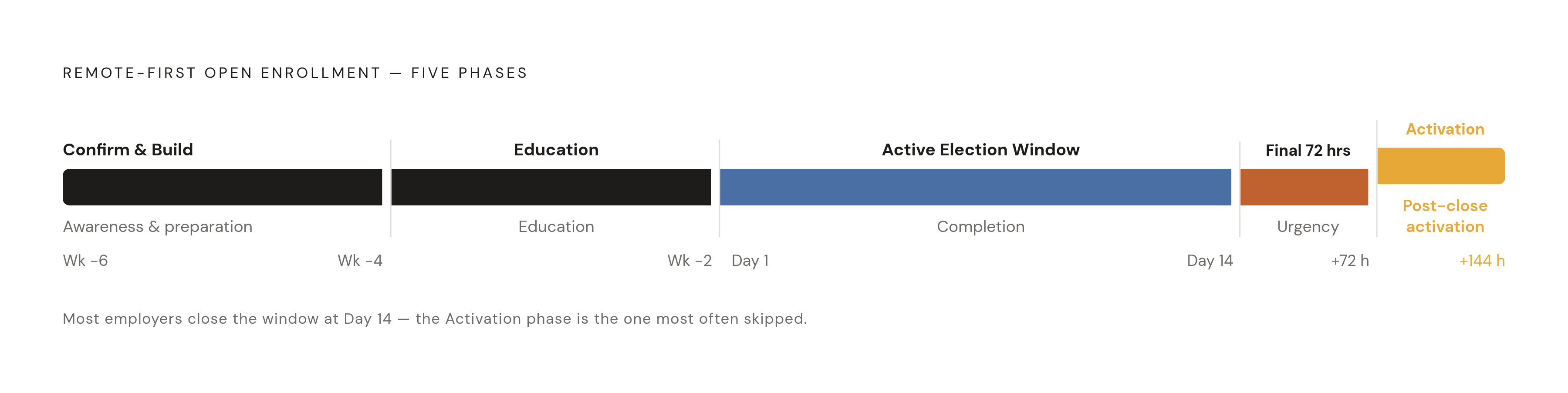
Going quiet after enrollment closes may feel like the natural end of the campaign, but it leaves a consequential job unfinished. An election records a choice without necessarily preparing the employee to use it. The next 72 hours should therefore be treated as an activation window. Communication now has a narrower purpose than education or election reminders.
Send each employee confirmation of their elections, including the cost per paycheck. State when coverage begins and what will arrive in the mail. Then prompt two or three concrete setup actions, including registering the carrier account, downloading the telehealth app, or activating the HSA.
The telehealth example makes the distinction clear. An employee with the app installed can use it when a child gets sick on a weekend, while an employee with identical coverage who has not completed setup may go to urgent care. The election is the same, but readiness differs.
Verify that elections match payroll deductions, confirm dependent documentation is complete, and document consistent application of the default-election policy for employees who did not act. Employees in states with individual mandate reporting requirements also need information about their coverage for that reporting. Those who declined coverage may need documentation for state filings, depending on their residence.
Multi-state compliance obligations that the communication timeline must account for, not treat as a separate project
The state-specific information needed after close depends on work done before the calendar is built. HR must know which states are in play because employees coordinating employer coverage with a state exchange face external enrollment deadlines. Those dates can affect the employee’s decision.
The 2025 plan year illustrates the variation. Covered California, the New Jersey Department of Banking and Insurance, and NY State of Health each published enrollment periods that ended January 31. HealthSource RI published an enrollment period that was extended through February 28. The DC Health Benefit Exchange Authority extended its original January 31 deadline to February 7, while the Idaho Department of Insurance set December 16 as the closing date for 2025 coverage, earlier than the federal window. These are historical dates, and current-year equivalents should be verified with the broker or carrier because state windows shift annually.
Address data creates a different constraint for COBRA administration. Notices must be mailed to the employee’s last known address in a manner reasonably calculated to ensure actual receipt. A missed notice may constitute non-compliance if the employer knew of a more current address but did not use it. Remote employees moving without updating HR records make address accuracy an enrollment-adjacent operational concern.
The ACA affordability and reporting calendar also belongs on the planning timeline. The deadlines for Form 1095-C furnishing, paper filing, and electronic filing fall in the months just after enrollment closes. Errors in election data can therefore carry forward into reporting work. State-specific deadlines, mini-COBRA obligations, and individual mandate reporting all require continuing ownership rather than a handoff once employees finish enrolling.
What a well-supported open enrollment looks like in practice, and the structural advantages of an AI-native brokerage model
Running this timeline well requires coordinated ownership of both information and execution. Someone must manage carrier confirmations, plan data, compliance dates, employee messages, completion tracking, manager readiness, household-facing content, and post-close activation. One HR generalist cannot reliably do all that work while also handling other duties. The service model matters because it determines which work the employer must still absorb.
A traditional commission-based broker model can be misaligned with that workload when incentives favor annual renewal over active plan management and enrollment support. Delivering the plan design does not itself deliver the campaign. The relevant distinction is therefore not simply who places coverage, but who supports the continuing work around it.
An AI-native brokerage model built for distributed companies shares that work through a different support structure. Automated compliance monitoring keeps track of each jurisdiction’s requirements throughout the year, so deadline checks happen more than once a year. Plan analysis against workforce data grounds change communications in actual cost impact. A companion app with 24/7 employee support lets employees and household members get answers outside business hours without sending every question to HR.
That structure is especially valuable during a first enrollment after leaving a PEO. The company must take over the calendar, platform, and compliance process for enrollment administration once handled under co-employment, often with the same small HR team. The practical standard is clear ownership from preparation through activation. A successful remote-first enrollment campaign is not defined by the announcement employees receive, but by the coordinated work that lets them understand, complete, and use their benefits.